
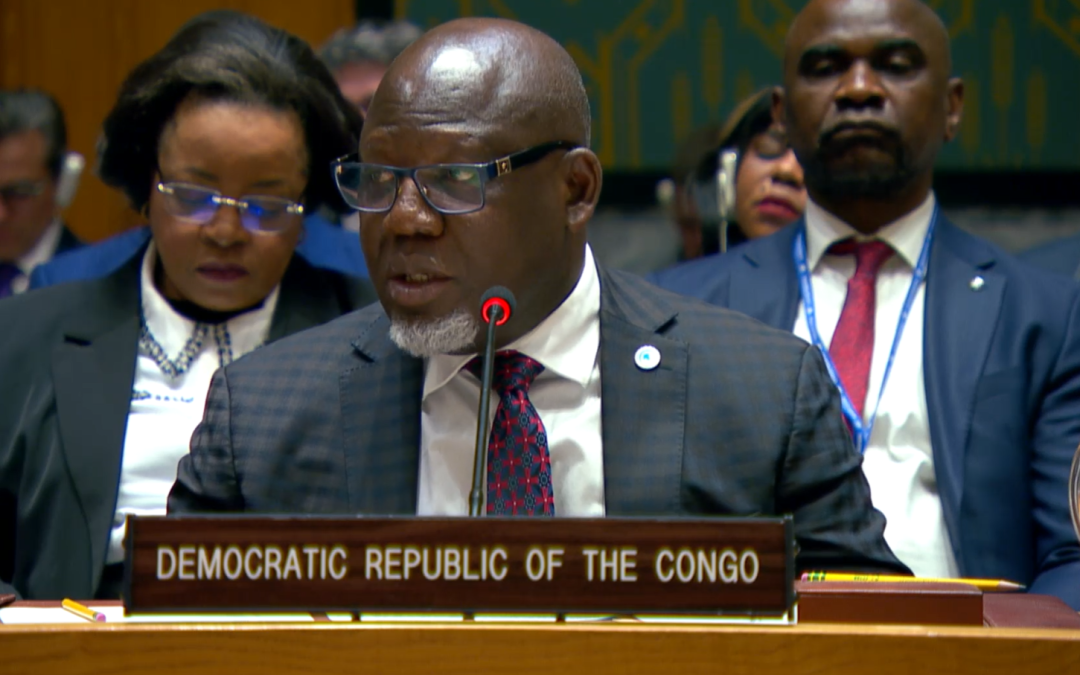
The Permanent Representative of the Democratic Republic of the Congo to the United Nations, Ambassador Zénon Mukongo Ngay, delivered the statement of the DRC at the Security Council’s 10114th meeting, held on Thursday, 5 March 2026, on the theme “Energy, Critical Minerals and Security.” The DRC reaffirmed its willingness to work with all partners to promote fair, transparent and responsible governance of natural resources, in the service of peace, security and sustainable development.
Below is the full statement.
Mr. President,
At the outset, allow me to welcome among us His Excellency Chris Wright, United States Secretary of Energy, and to thank Ms. Rosemary DiCarlo, Under-Secretary-General, for her earlier briefing.
Mr. President,
At a time when the world is undergoing a profound energy and digital transition, and as the race for strategic minerals intensifies, the Democratic Republic of the Congo could only support the initiative taken by the United States of America to place on the agenda of the Security Council a topic that is, for our country, of particularly existential importance.
As a country endowed with immense reserves of strategic minerals essential to modern technologies and the global energy transition, the Democratic Republic of the Congo finds itself at the very heart of this global issue. Yet these resources, which should represent a powerful driver of development and prosperity for our populations, have instead largely attracted intense competition, contributing to persistent cycles of violence in certain regions of our territory.
Mr. President,
The 21st century is characterized by the emergence of strategic mineral resources — including cobalt, coltan, lithium, gold and rare earth elements — which have become essential pillars of the technological and energy transformations of our time.
This dynamic is also accompanied by growing risks to international peace and security. In certain fragile contexts, competition for the control of natural resources fuels cycles of violence and contributes to the emergence of a war economy. Illegal artisanal mining, informal taxation and cross-border smuggling networks enable certain armed groups to finance their activities and sustain prolonged conflicts.
My country provides a clear illustration of this reality.
Indeed, for nearly three decades, the eastern part of the Democratic Republic of the Congo has remained the scene of persistent violence largely fueled by the illegal exploitation and trade of natural resources. This situation has plunged millions of civilians into chronic insecurity, caused massive population displacements, and durably weakened economic and social structures.
This is also an appropriate moment to thank the United States for having taken the step of imposing targeted sanctions against the troublemakers in the Great Lakes region, namely the Rwandan Defence Forces and their M23 auxiliaries.
In certain areas rich in strategic minerals essential for the global energy transition and advanced technologies, civilian populations remain particularly exposed to violence and abuses. Several United Nations expert reports have established a direct link between the illegal exploitation of natural resources and the persistence of armed conflicts in this region.
Mr. President,
Beyond this situation, the correlation between natural resources and armed conflicts can be observed in several regions of the world. In certain parts of the Sahel, in some areas of the Middle East, and in parts of Latin America, competition for control over strategic resources — whether hydrocarbons, minerals or other natural wealth — continues to fuel tensions and undermine regional stability.
These dynamics also contribute to cross-border destabilization, notably through refugee flows, organized crime, human rights violations and the militarization of resource-rich areas. They demonstrate that the governance of natural resources has become a central issue for the maintenance of international peace and security.
Mr. President,
In response to these challenges, it is essential to promote responsible, transparent and inclusive governance of mineral resources. It is crucial that producing States fully exercise their sovereignty over the resources of their subsoil, while ensuring that their exploitation genuinely contributes to the economic and social development of their populations.
In this regard, several priorities deserve particular attention: strengthening traceability and transparency in critical mineral supply chains; promoting local value creation, notably through the processing of minerals in producing countries; and effectively combating fraud, smuggling and the illegal exploitation of natural resources.
Mr. President,
The Democratic Republic of the Congo does not approach this issue solely from an analytical perspective. It is actively engaged in several initiatives aimed at strengthening transparency and governance of natural resources.
In this regard, my country participates in the Kimberley Process for diamond traceability, as well as in the Regional Certification Mechanism established by the International Conference on the Great Lakes Region (ICGLR), which applies the OECD due diligence principles for responsible mineral supply chains.
These initiatives demonstrate that concrete instruments already exist to promote responsible exploitation of natural resources. They could usefully inspire the strengthening of a more coherent and effective international framework to prevent the use of natural resources in financing conflicts.
In conclusion, Mr. President, allow me to highlight the following points:
-
The private sector plays an essential role in the mining industry and in global supply chains. As such, its involvement must be conducted in strict compliance with national legislation and the principles of social and environmental responsibility;
-
Companies operating in this sector must ensure that their activities do not in any way contribute to the financing of armed groups or to the illegal exploitation of natural resources. They must also contribute to the sustainable development of the countries in which they operate, notably through technology transfer, the training of local human resources and the implementation of community development projects;
-
At a time when the world is embarking on a major energy transformation, it is essential that this transition does not reproduce the injustices of the past;
-
The energy transition will only be truly sustainable if it is also fair, responsible and beneficial to the peoples of the countries that produce these resources.
Finally, the Democratic Republic of the Congo reiterates its willingness to work with all its partners in order to promote equitable, transparent and responsible governance of natural resources, in the service of peace, security and sustainable development.
I thank you.