
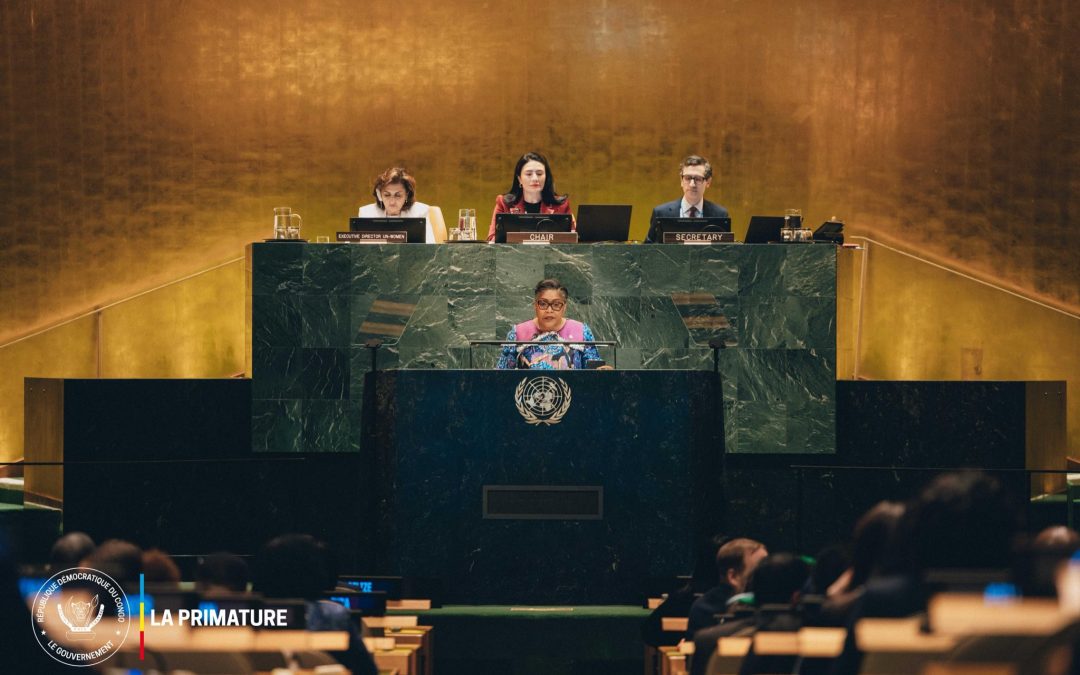
The Prime Minister of the Democratic Republic of the Congo, Her Excellency Judith Suminwa Tuluka, addressed the United Nations General Assembly on Monday, 9 March 2026, during the 70th session of the Commission on the Status of Women (CSW70), taking place from 9 to 19 March at the United Nations Headquarters in New York, under the presidency of Costa Rica.
The Prime Minister emphasized that, under the leadership of the President of the Republic, Félix-Antoine Tshisekedi Tshilombo, recognized by his peers as a Champion of Positive Masculinity in Africa, significant progress has been achieved in women’s participation in public life and in decision-making bodies. She notably pointed out that women’s representation in decision-making spheres increased from 21% in 2021 to 32% in 2024, an evolution also marked by the appointment, for the first time in the country’s history, of a woman as Head of Government.
Below is the full text of her statement.
Excellencies,
Ladies and Gentlemen Heads of Delegation,
Madam President,
Distinguished representatives of the United Nations,
Dear technical and financial partners,
Dear representatives of civil society,
Ladies and Gentlemen,
Thirty years after the Beijing Declaration and Platform for Action, the international community is called upon to transform its commitments into tangible results for women and girls around the world.
I thank you for giving me the floor during this 70th session of the Commission on the Status of Women.
This anniversary goes beyond mere commemoration. It represents a moment of truth for the international community. It invites us to measure the gap between our commitments and the realities experienced by millions of women worldwide, particularly those subjected to the most extreme forms of violence in conflict zones.
The question before us today is simple yet essential: are we truly capable of effectively protecting women, sanctioning violations of their rights, and sustainably addressing the injustices they endure?
The 70th session of this Commission must therefore be a moment of responsibility and renewal. Promoting women’s rights requires coherence and credibility. Such credibility demands a constant alignment between the influence exercised within our decision-making bodies and the principles we collectively uphold, including in relation to certain States involved in conflict dynamics.
In this spirit, the Democratic Republic of the Congo continues its efforts to strengthen women’s rights, which are considered a fundamental pillar of a just and inclusive society.
The principle of equality between women and men is enshrined in the Constitution of the Democratic Republic of the Congo, particularly in Article 14, which commits public authorities to eliminate all forms of discrimination and actively promote women’s rights.
To translate this principle into practice, several major reforms have been adopted. The revision of the Family Code in 2016 marked a significant milestone by removing certain discriminatory provisions, including the marital authorization requirement that limited women’s autonomy. This reform also established 18 years as the legal age of marriage for both girls and boys.
In the same year, the law on the implementation of women’s rights and gender parity was adopted to promote balanced participation of women and men in public affairs and to strengthen women’s representation within institutions.
Under the leadership of President Félix-Antoine Tshisekedi Tshilombo, recognized by his peers as a Champion of Positive Masculinity in Africa, significant progress has been made. Women’s participation in decision-making spheres increased from 21% in 2021 to 32% in 2024, notably with a government led for the first time by a woman Prime Minister.
The Democratic Republic of the Congo is also committed to strengthening women’s economic empowerment by supporting entrepreneurship and facilitating women’s access to economic opportunities, particularly within the framework of the Local Development Program for the 145 Territories.
However, our country continues to face major challenges related to peace and security. Since the aggression carried out by Rwanda and supported by the M23/AFC group, women and girls in the affected areas have been subjected to serious violence, displacement, and a humanitarian crisis that deeply affects their lives and their future.
Ladies and Gentlemen,
Conflicts do not affect men and women in the same way. Violence against women must neither be ignored nor trivialized. It must be recognized and addressed with determination.
Equality between women and men cannot remain a principle proclaimed in texts; it must become a reality experienced in the daily lives of every woman and every girl.
Our collective responsibility, therefore, is to transform our commitments into concrete action and to build a future where equality, justice, and peace become a reality for all.
I thank you.