
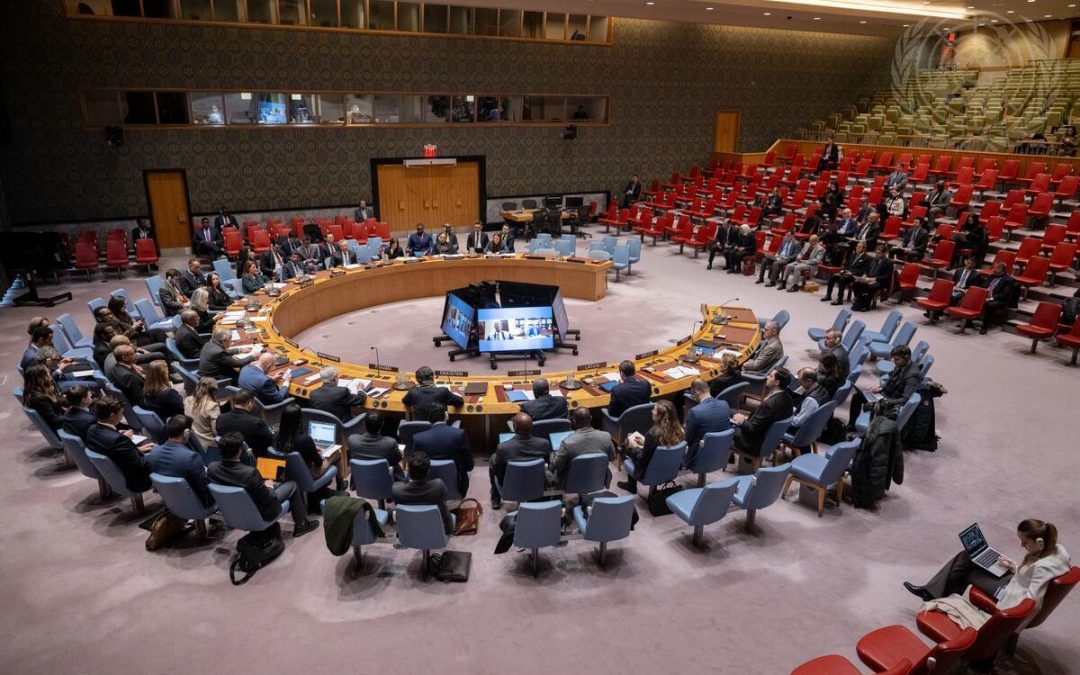
New York, January 26, 2026 – During the 10096th meeting of the United Nations Security Council, devoted to the promotion and strengthening of the rule of law in the maintenance of international peace and security, the Democratic Republic of the Congo reaffirmed its deep commitment to the founding principles of the Charter of the United Nations. The Congolese statement was delivered by the Deputy Permanent Representative, Ambassador Jocelyne Kabengele Lukundula.
Speaking during an open debate held under the presidency of the Federal Republic of Somalia, the DRC welcomed the convening of this meeting at a highly symbolic moment, as the international community marks the eightieth anniversary of the Charter of the United Nations. The Congolese delegation also paid tribute to the distinguished dignitaries in attendance, notably the Secretary-General of the United Nations, Mr. António Guterres, the Chairperson of the African Union Commission, H.E. Mahmoud Ali Yusuf, as well as Judge Abdulqawi Yusuf, founding President of the African Institute of International Law.
As a country affected by persistent armed conflicts, the Democratic Republic of the Congo recalled that its commitment to international peace and security is grounded in scrupulous respect for the international rule of law, the cornerstone of the multilateral system. Eighty years after the adoption of the Charter, the delegation emphasized, the Security Council is called upon to undertake a clear-eyed reflection on the achievements made, but also on the persistent challenges, in a context marked by the gradual erosion of international legal norms and the weakening of multilateralism.
The DRC stressed that the international rule of law rests on respect for the Charter, the good-faith implementation of international obligations, and the strengthening of the three pillars of the United Nations: peace and security, human rights, and development. It expressed concern over repeated violations of the fundamental principles enshrined in the Charter, notably respect for sovereignty, territorial integrity, and the prohibition of the use of force, which undermine the credibility of the international legal order.
In this regard, the security situation in eastern DRC was mentioned as a concrete illustration of the limitations of the multilateral system when Security Council decisions are not fully implemented. While reaffirming its commitment to regional mechanisms for the peaceful settlement of disputes, under the aegis of the African Union and in accordance with Chapter VIII of the Charter, the DRC underscored the need for the effective implementation of Council resolutions, particularly those relating to respect for territorial integrity and the cessation of any non-consensual foreign military presence.
In a global context marked by the resurgence of conflicts, the rise of unilateralism, and the impact of global crises, the Congolese delegation called for a renewed affirmation of multilateralism and of the central role of the international rule of law as the preferred means of conflict prevention and the building of lasting peace. It advocated a more systematic use of the tools provided for under Chapter VI of the Charter, notably mediation, preventive diplomacy, and recourse to international judicial mechanisms.
The DRC also highlighted the importance of better coordination among United Nations organs, as well as stronger partnership with regional organizations, particularly African ones, whose role is becoming increasingly decisive in the peaceful settlement of disputes and in strengthening the institutional capacities of States.
In conclusion, the Democratic Republic of the Congo called on the Security Council to fully assume the responsibility conferred upon it by Article 24 of the Charter by placing the promotion and strengthening of the rule of law at the heart of all United Nations actions. It reaffirmed its unwavering attachment to the ideals of the Charter and its commitment to working, alongside the international community, toward the emergence of a world order based on law, justice, and multilateralism, as guarantees of lasting and inclusive peace.