
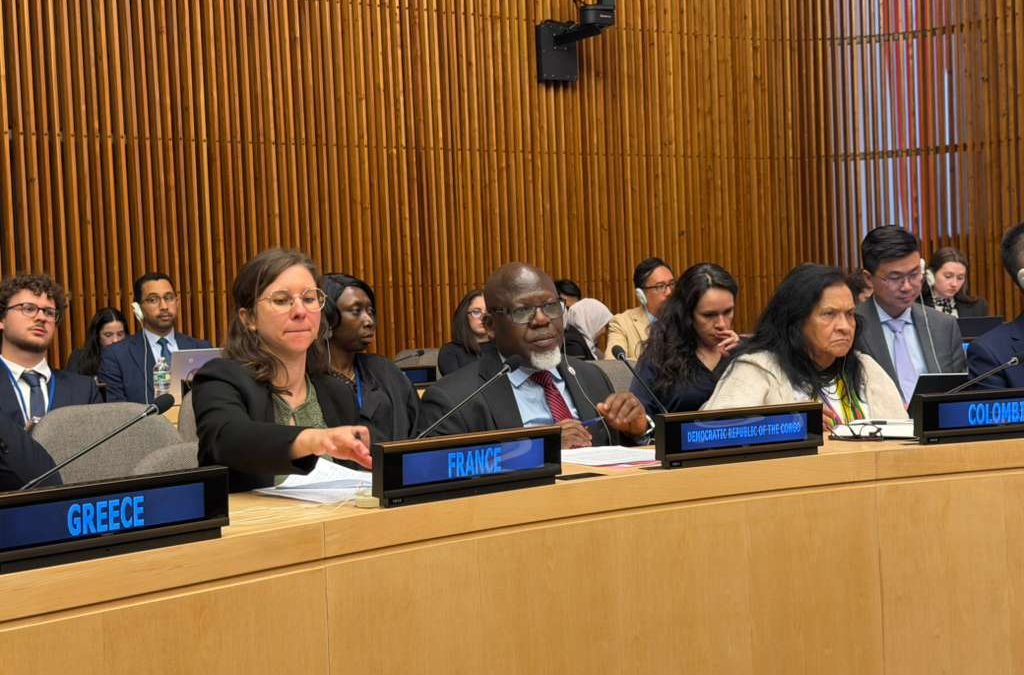
New York, 5 May 2026 — The Democratic Republic of the Congo took part, on Tuesday, 5 May 2026, in an Arria-formula meeting of the United Nations Security Council, held in the ECOSOC Chamber and organized by Denmark, New Zealand and Spain. The meeting was devoted to the tenth anniversary of Resolution 2286 (2016), concerning the protection of medical care in armed conflict.
In its statement, delivered by Ambassador Zénon Mukongo Ngay, Permanent Representative of the Democratic Republic of the Congo to the United Nations, the DRC welcomed the convening of this meeting at what it described as a critical juncture, ten years after the adoption of this important Security Council resolution.
The DRC recalled that attacks against health care have now reached an alarming level in several conflict theatres, including the Middle East, the Sahel, the Great Lakes region, Ukraine, Myanmar, Sudan and Haiti. It stressed that health facilities, medical personnel, humanitarian workers and patients continue to be targeted or obstructed in the performance of their duties.
Referring to the painful experience of the Democratic Republic of the Congo, particularly in the eastern part of the country, the Congolese delegation stated that attacks against health facilities, medical convoys, patients, and humanitarian and medical personnel seriously undermine access to health care and the continuity of essential services. It also emphasized that such acts violate international humanitarian law, medical neutrality and the protection of civilian populations.
The DRC stated that Resolution 2286 should not be regarded solely as a normative framework, but also as an operational instrument for prevention, documentation and accountability. In this regard, it called for increased attention by the Security Council, including through sanctions regimes, to the perpetrators, sponsors and supporters of attacks against health care.
The Democratic Republic of the Congo proposed several avenues for action, including the systematic integration of the protection of health care into the mandates of peace operations, the strengthening of early warning through more detailed reports by the Secretary-General, the establishment of an inter-agency mechanism dedicated to the protection of medical missions, and the promotion of renewed political commitments within the Security Council.
The Congolese delegation also highlighted national efforts, including the integration of the protection of health care into the operational directives of the Armed Forces of the Democratic Republic of the Congo, the development of mandatory training in international humanitarian law, the establishment of temporary humanitarian corridors, and the strengthening of cooperation with humanitarian partners and United Nations agencies.
In conclusion, the DRC stressed the need to transform the commitments made since the adoption of Resolution 2286 into concrete action, fully adapted to field realities and emerging risks. For the Democratic Republic of the Congo, the protection of health care in times of conflict is both a legal obligation and a moral, humanitarian and collective security imperative.