
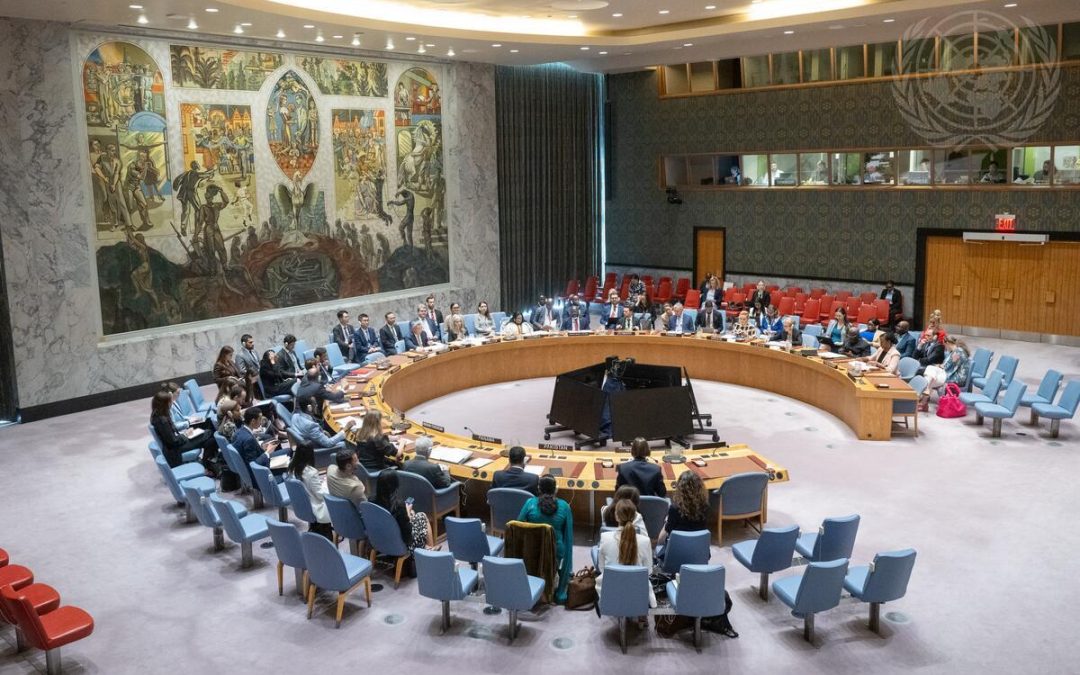
At the 10,154th meeting of the Security Council, dedicated to the protection of civilians in times of conflict, the Democratic Republic of the Congo reaffirmed its commitment to international humanitarian law, the principles of the United Nations Charter, and the effective protection of civilian populations, medical personnel, and humanitarian workers.
In its statement, delivered by Ambassador Zénon Mukongo Ngay, the DRC emphasized that the protection of civilians must extend beyond a strictly security-based response. It must be based on strengthening national capacities, conflict prevention, addressing the root causes of instability, unimpeded humanitarian access, the fight against impunity, and a coherent political strategy for peace.
The statement by the Democratic Republic of the Congo is published in full below.
——————————————————————————————————————————————–
Mr. President,
The Democratic Republic of the Congo thanks China for organizing this open debate on the protection of civilians in armed conflict, as well as Ms. Edem Wosornu and Ms. Mirjana Spoljaric for their presentations and for the ongoing commitment of their respective institutions to populations affected by armed conflict.
The Democratic Republic of the Congo welcomes these timely discussions, which take place against an international backdrop marked by a worrying and prolonged deterioration of international peace and security, as evidenced in particular by the proliferation of conflict zones that are equally complex and interconnected, and for which civilian populations pay a heavy price.
Mr. President,
Eighty years after the founding of our Organization, it is unfortunately clear that the promises and objectives of the United Nations’ founders regarding peace, security, and respect for human rights remain profoundly fragile.
The proliferation of conflict zones, their complex interconnections, not to mention the growing sophistication of hostilities and the gradual blurring of the line between military and civilian spheres, are all warning signs to which the international community must respond with the utmost firmness. For at the very heart of this conflict-prone web lie populations exposed to forced displacement and indiscriminate violence; tragic situations that are often accompanied by the destruction of essential infrastructure and constraints as unspeakable as they are unacceptable, which weigh heavily on humanitarian workers
This picture would be incomplete if we failed to identify the underlying dynamic: the erosion of diplomacy in favor of a logic of total confrontation. Yet we observe that wherever diplomacy recedes and dialogue gives way to a logic of confrontation with no political horizon, it is invariably the civilian population that bears the most dramatic consequences. Every further escalation, every intensification of hostilities, pushes the prospects for a peaceful and lasting settlement a little further away, thereby undermining the very foundations upon which our collective architecture of peace and security rests.
Even more concerning is that, amid this dynamic of escalating conflict, medical facilities, medical convoys, and humanitarian and medical personnel remain, in a particularly alarming manner, exposed to recurring attacks in clear violation of international humanitarian law.
Mr. President,
Ten years after the adoption of resolution 2286 (2016), the Secretary-General’s annual report documents more than 37,000 civilian deaths across twenty armed conflicts in 2025. These figures are not mere statistics: they reflect a profound erosion of respect for international humanitarian law and persistent impunity, which this Council has a responsibility to combat.
The Democratic Republic of the Congo, a country that has faced persistent conflicts for several decades, knows this reality all too well. In the eastern part of the country, successive reports by the United Nations Group of Experts have documented the persistence of serious violations of international humanitarian law committed by armed groups as well as by externally supported elements, including attacks against civilians, sites housing displaced persons, and critical infrastructure. Humanitarian organizations, including Doctors Without Borders, have repeatedly warned of the continuing deterioration of the security situation in certain conflict-affected areas.
Furthermore, MONUSCO’s experience in eastern Democratic Republic of the Congo illustrates both the importance and the limitations of international protection mechanisms when they are not accompanied by sustained efforts to strengthen national capacities, address the root causes of conflict in a sustainable manner, and demonstrate a consistent political commitment to peace. It also demonstrates that the protection of civilians cannot be viewed solely through a security lens, but must be part of an integrated approach combining security, development, justice, peacebuilding, and political dialogue.
That is why, recalling that the primary responsibility for protecting civilians lies with States, my delegation reaffirms that international support produces lasting results only when it strengthens legitimate institutions, consolidates national protection mechanisms, and addresses the root causes of instability. Furthermore, conflict prevention and the peaceful settlement of disputes remain essential conditions for the sustainable protection of civilians.
For example, the Democratic Republic of the Congo has undertaken, in coordination with its partners, concrete efforts to train its defense and security forces in international humanitarian law, as well as to establish national mechanisms for reporting and monitoring violations. These initiatives, though still fragile, demonstrate the national authorities’ commitment to fully assuming their primary responsibility for the protection of civilian populations and deserve to be supported and expanded by the international community
Mr. President,
My delegation believes that the Security Council must continue its efforts to ensure the effective implementation of its relevant resolutions, in particular resolutions 2286 (2016) and 2573 (2021). These instruments remain essential benchmarks for the protection of medical care in times of conflict and for the fight against impunity. Their full implementation requires not only renewed political commitments, but also strengthened monitoring mechanisms and a collective will to ensure compliance with their provisions. Impunity remains, in fact, one of the main factors behind the recurrence of violations committed against civilian populations and humanitarian personnel.
In view of the scale of the challenges we have just outlined, collective initiatives that offer hope deserve to be commended and supported. In this regard, the Democratic Republic of the Congo welcomes the launch of the Global Initiative aimed at galvanizing political commitment to international humanitarian law. Indeed, the protection of civilians cannot be separated from the preservation of multilateralism, respect for international law, and a return to a culture of dialogue and compromise in international relations.
Mr. President,
In conclusion, the Democratic Republic of the Congo reaffirms its unwavering commitment to international humanitarian law and to the principles enshrined in the Charter of the United Nations. It calls on all parties to armed conflicts to break with any logic of escalation, to comply scrupulously with their international obligations, to guarantee safe, rapid, and unimpeded humanitarian access, and to ensure the effective protection of civilians, medical personnel, and humanitarian workers. In this regard, it would like to highlight three points:
First, the Council and international partners must ensure that mandates, resources, and support for national capacity-building are clearly defined, closely coordinated, and fully adapted to the realities on the ground, particularly in the areas of security, justice, early warning, and community protection.
Second, the protection of civilians must be part of sustainable investments in peacebuilding, development, and addressing the root causes of conflict—the only way to produce lasting results on the ground.
Third and finally, support for national authorities must be part of a coherent political strategy that coordinates efforts at the local, national, regional, and international levels to promote peace, preserve state sovereignty, and support the effective implementation of ceasefire commitments.
Thank you.