
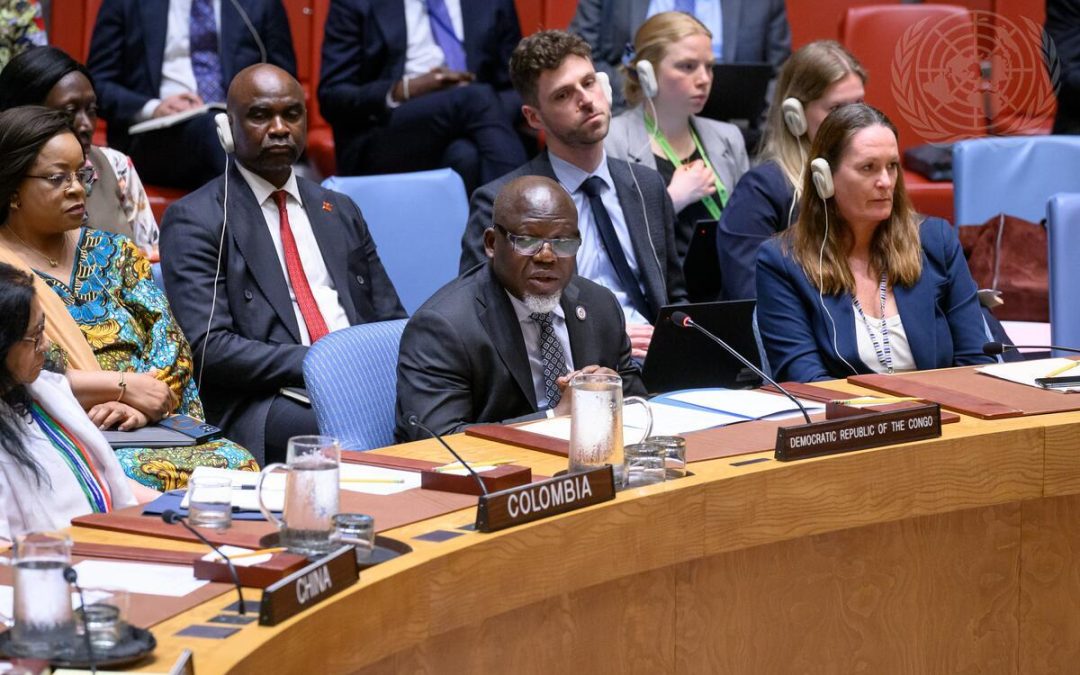
At the 10136th meeting of the Security Council on the situation in the Great Lakes region, the Democratic Republic of the Congo reaffirmed that its sovereignty and territorial integrity are non-negotiable, while calling for the strict implementation of the Council’s resolutions, the unconditional withdrawal of Rwandan troops, and the strengthening of regional and UN mechanisms in support of peace.
The full statement delivered by Ambassador Zénon Mukongo Ngay is published below.
————————————————————
Thank you very much, Madam President,
Madam President,
Allow me first of all to pay tribute to His Excellency Mr. António Guterres, Secretary-General of the United Nations, for his sustained commitment to peace in the Democratic Republic of the Congo and in the region, and I would also like to thank his Special Envoy, Ambassador Huang Xia, for his briefing today.
I would also like to thank the Executive Director of UN-Women, Ms. Sima Sami Bahous, for shedding light before the Council on the suffering of Congolese women and children in the part under occupation by Rwanda and the AFC/M23.
My delegation had not wished to speak at this stage, especially after the A3 statement, with which we fully associate ourselves. However, the statement we have just heard leaves me with little choice.
Allow me, in my national capacity, to make a few additional comments.
We have first taken note of the Secretary-General’s report on the implementation of the Peace, Security and Cooperation Framework for the Democratic Republic of the Congo and the region, document S/2026/256 of 31 March 2026. The following emerges from it:
First, the situation in the Democratic Republic of the Congo and in the region has been marked by numerous diplomatic efforts at the international and regional levels, in particular through the ceasefire monitoring and verification mechanism of 14 October, the Doha Framework Agreement of 15 November 2025, the Washington Agreements of 4 December, as well as strengthened coordination of African peace efforts.
I wish to stress the complementary nature of all these processes, whose point of convergence remains the full implementation of the relevant provisions of Security Council resolutions 2773 and 2808, resolutions which strongly condemn the M23 offensive and the violence in eastern Democratic Republic of the Congo, call for an immediate ceasefire, demand the withdrawal of M23, and call upon Rwanda and the Rwanda Defence Force to cease their support for M23 and to withdraw from the territory of the Democratic Republic of the Congo, while reaffirming the sovereignty and territorial integrity of the Democratic Republic of the Congo.
Despite all these initiatives, there remains serious concern, in the light of recent developments, about the sincerity of Rwanda’s commitment and that of its auxiliaries, who persist in trampling upon the commitments they undertook under the above-mentioned agreements.
Is it still necessary to recall that, during an interview with Jeune Afrique at the beginning of this month of April, and during a national dialogue in February 2026, the Rwandan authorities acknowledged the presence of Rwandan troops in eastern DRC? Describing those actions as indispensable defensive measures, they denied the plundering of the DRC’s natural resources and refused to yield to what they call “the threat of international sanctions.” That is precisely why all peace initiatives taken at the regional and international levels have remained a dead letter.
This is notably the case with the peace plan resulting from the Luanda and Nairobi processes, processes whose implementation Rwanda deliberately blocked in order to buy time and pursue its disproportionate ambition to establish in the DRC a sphere of influence that it would turn into a colony for exploitation and settlement, and from which it would control Congolese institutions.
These actions by Rwanda are unacceptable and violate regional peace as well as the provisions of the Addis Ababa Framework Agreement, to which that country had nevertheless freely subscribed.
Second, the continuation of the fighting is an obstacle to any cessation of hostilities. It reflects the gap between diplomatic efforts and the reality of the security dynamics on the ground, as the Secretary-General states in his report. The report rightly highlights the continuing violence in eastern Democratic Republic of the Congo, with intensified military clashes, and condemns the territorial expansion of AFC/M23, whose offensive launched in South Kivu in December 2025, only a few days after the signing of the Washington Agreements, it strongly criticizes.
My delegation therefore wishes to reiterate its deep concern over the persistence of hostilities in its eastern part. Once again, AFC/M23, supported by Rwandan forces, continue their offensive toward Uvira, threatening the security not only of the Democratic Republic of the Congo, but also that of Burundi, a neighbouring country and signatory of the Addis Ababa Framework Agreement.
In accordance with Security Council resolutions 2773 and 2808, AFC/M23 must cease hostilities and dismantle, in their entirety, the illegitimate parallel administrations established in eastern Democratic Republic of the Congo. The sovereignty and territorial integrity of the Democratic Republic of the Congo must be preserved.
However, it is incumbent upon the Security Council, now that responsibility for the current escalation and the continuation of hostilities has been clearly established, to take the measures required to restore peace in that part of my country. For now, I invite you to note that this situation has led to the displacement of more than 7 million Congolese.
The statistics are appalling. As we know, more than 70 per cent of them are women and girls. Deprived of their most basic vital needs, these Congolese women have lost all human dignity, many of them having suffered rape, sexual violence, and other cruel, inhuman and degrading treatment, particularly in mining areas.
Madam President,
The position of the Democratic Republic of the Congo has never changed.
Rwandan troops must immediately leave the territories of the Democratic Republic of the Congo, and do so unconditionally, as required by resolution 2773, which this Council adopted unanimously.
Rwanda’s other negative activities in the Great Lakes, through its many proxies, must also cease, otherwise durable peace will never emerge in this region.
For my delegation, let it be clearly stated that the sovereignty and territorial integrity of the DRC, enshrined in the Charter of the United Nations, are not negotiable. My country, which has been attacked, will recover every square inch of its territory that continues to be gravely violated.
Congolese civilians in the martyred eastern part continue to pay the heaviest price of this thirty-year conflict. Women and children displaced, abused by the thousands. Sexual violence against women, children deprived of school, recruited into armed groups and subjected to forced labour in the mines. To this must also be added attacks against humanitarian personnel and peacekeepers. These unacceptable and ongoing violations of international humanitarian law and human rights, documented by the United Nations, are part of the daily reality in the Great Lakes.
In the light of this reality, the Democratic Republic of the Congo calls on the Council to maintain maximum pressure on Rwanda and its proxies, and to ensure that its decisions are enforced on the ground.
In such a context, my delegation reiterates its position regarding the strengthening of MONUSCO’s role in monitoring the ceasefire in order to stabilize the situation in the DRC. The same applies to the Office of the Special Envoy for the Great Lakes, to address this conflict clearly identified as regional.
The regional dimension of this conflict must be reaffirmed in order to ensure a better approach to solutions. In my delegation’s view, this is not the time to deprive these two entities of adequate resources for the full implementation of their respective mandates, which could spare one country and an entire region threatened by conflagration.
The Democratic Republic of the Congo, in the image of its President, His Excellency Félix-Antoine Tshisekedi Tshilombo, a man of peace, will continue in good faith to subscribe to diplomatic efforts for peace in the DRC and in the Great Lakes region.
From Doha to Washington, here in the Security Council and within the African Union, the Democratic Republic of the Congo will remain in good faith in seeking peace with all its neighbours. The success of this approach requires, in return, that all signatory partners and guarantors of the Addis Ababa Framework Agreement be animated by the same spirit and the same determination for a peaceful, stable and prosperous Great Lakes region.
Madam President,
When the Representative of Rwanda, referring to the 1994 Rwandan genocide, tells you that those responsible for that genocide are in the Democratic Republic of the Congo, you may get the impression that he is speaking about Congolese. He is not speaking about Congolese; he is speaking about Rwandans. The FDLR they are talking about are Rwandans who fled Rwanda and entered the territory of the Democratic Republic of the Congo precisely because in Rwanda there are only two tribes confronting each other. In Rwanda, it is impossible for these two tribes to coexist, whereas in the Democratic Republic of the Congo there are 450 tribes living together in perfect harmony.
Therefore, the genocidal ideology that Rwanda seeks to transpose onto Congolese territory is incompatible with the very nature of the Congolese people. That is why we say that the narrative they are spreading may be valid for Rwanda, but it is not valid for the Democratic Republic of the Congo. The FDLR came from Rwanda.
Some time ago, an eminent Rwandan ambassador posted in Kinshasa stated that the FDLR no longer constituted a threat to Rwanda. It is all over the internet; one can follow the remarks of that eminent Rwandan ambassador. It is cyclical: today they tell you about the FDLR, tomorrow they tell you about hate speech, and the next day they will produce yet another card.
So let us speak about hate speech. You have a country, armed to the teeth, that enters your country’s territory, massacres your women, massacres your relatives, massacres your children, and then expects you to greet it with words of welcome. Where has that ever been seen? Rwanda gives us the impression today that hate speech is more serious than massacres. How many Congolese have they massacred since they occupied Goma, Bukavu, Uvira? How many? And that is comparable to hate speech? In fact, hate speech is the consequence of the massacres they are carrying out. So hate speech is not the cause of the situation they face; they themselves are the cause of the hate speech.
Now, Madam President,
I will not overdo it. They spoke of the protection of Rwandophone populations in the Congo. They are speaking of the Banyamulenge. They are Congolese. They are not Rwandans. So simply because these Rwandans resemble those Congolese, they believe they have the right to enter Congolese territory and protect Congolese people. What audacity. What audacity. Where has such a thing ever been seen? In what country? Where a foreigner comes into your country and says: “The people of your country resemble the people of my country, so I am coming to protect them.”
The truth is known: it is about the exploitation of the natural resources of the Democratic Republic of the Congo, and we will not remain silent in repeating it. Rwanda is today occupying the Rubaya mines. Rwanda has become an exporter of coltan, although there is no coltan anywhere in Rwandan subsoil. Yet they come to speak to you about hate speech.
That is the essential point: you do not have the right, dear colleague, to come and protect Congolese populations on their own territory. The Democratic Republic of the Congo is fully capable of protecting its own populations, a country of 450 tribes; but you, who have only two and cannot manage them, want to come and manage our 450 tribes. Be modest.
I thank you, Madam President, and I apologize for having spoken a little longer. I will not take the floor again.