
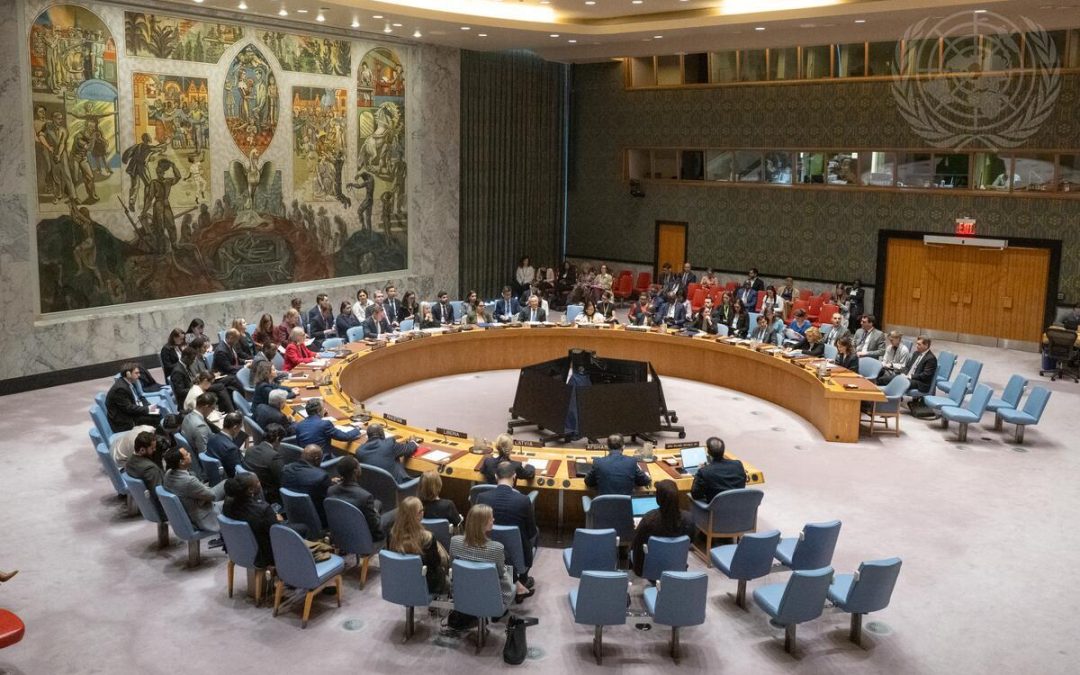
The Permanent Representative of the Democratic Republic of the Congo to the United Nations, Ambassador Zénon Mukongo Ngay, delivered the A3 statement (Liberia, Somalia and the Democratic Republic of the Congo) at the Security Council’s 10116th meeting, held on Thursday, 9 March 2026, on the situation in Afghanistan.
The three African non-permanent members of the Council — the A3 — stressed the need for a coordinated and integrated approach among political, humanitarian and development actors in order to effectively address the multiple challenges facing the Afghan people. They reaffirmed their commitment to supporting Afghanistan in its pursuit of sustainable peace, security, stability and development.
Below is the full statement.
Mr. President,
I have the honor to deliver this statement on behalf of the A3 countries, namely Liberia, Somalia and my own country, the Democratic Republic of the Congo.
We thank the Deputy Special Representative of the Secretary-General for Afghanistan and Acting Head of the United Nations Assistance Mission in Afghanistan (UNAMA), Ms. Georgette Gagnon, for her comprehensive briefing. We also welcome the presence of Her Excellency Baroness Jacqui Smith, Minister of State of the United Kingdom.
Mr. President,
The A3 remain concerned about the complex political, humanitarian and socio-economic challenges facing Afghanistan. The Afghan people continue to endure the consequences of prolonged instability, compounded by economic hardship and limited access to essential services.
The A3 reaffirm the importance of sustained international support for the Afghan people.
In this regard, we wish to highlight the following points:
First, the A3 reiterate their firm commitment to the sovereignty, independence, territorial integrity and national unity of Afghanistan.
Second, the A3 reiterate their unwavering support for the continued work of UNAMA, while emphasizing the essential role played by the Mission as a key platform for international engagement and coordination of humanitarian and development efforts in Afghanistan.
In this regard, it is important to ensure that the Mission can operate under conditions that enable it to effectively carry out its mandate, including by guaranteeing safe and unhindered access for United Nations personnel and partners.
Third, the A3 express deep concern over the worsening humanitarian situation in Afghanistan, as the combined effects of declining international assistance, massive returns of displaced populations, natural disasters and disruptions to regional trade continue to place immense pressure on Afghan communities.
The A3 are gravely alarmed by the sharp deterioration in food security, with 21.9 million people expected to require humanitarian assistance in 2026.
The 2026 Humanitarian Needs and Response Plan requires $1.71 billion to deliver life-saving assistance. The A3 commend the continued efforts of the United Nations and humanitarian partners, who are working under extremely difficult conditions, and urge donors to act swiftly to close the funding gaps.
Fourth, the A3 consider that the full participation of women and girls is one of the cornerstones of Afghanistan’s successful reintegration into the international community. We stress that ensuring access to education, employment, fundamental freedoms and meaningful participation in society will unlock the country’s full potential and safeguard the dignity of its people.
The A3 are also concerned about the restrictions preventing Afghan female United Nations staff from accessing UNAMA premises. In this regard, we call on the authorities to allow national female UN staff to return to their workplaces.
Fifth, the A3 remain concerned about the persistent threats posed by terrorist groups operating in Afghanistan and reaffirm that Afghan territory must not serve as a safe haven for terrorist activities that undermine regional and international peace and security.
Furthermore, the A3 urge countries in the region to strengthen their support for efforts aimed at countering the threats posed by terrorist organizations operating on Afghan territory.
In this context, the A3 emphasize the importance of the Security Council’s sanctions regime on Afghanistan and reiterate their support for the work of the 1988 Sanctions Committee.
Sixth, the three countries reaffirm that engagement between the international community and Afghanistan is essential for the country’s sustainable peace, stability and socio-economic development.
We take note of the Secretary-General’s call on all members of the Doha process and the Afghan authorities to further engage in the comprehensive approach proposed under Security Council resolution 2721 (2023), with a view to achieving the full reintegration of Afghanistan into the international community.
In conclusion, Mr. President, we emphasize the importance of a coordinated and integrated approach among political, humanitarian and development actors in order to better address the multiple challenges facing the Afghan people.
The A3 reaffirm their unwavering solidarity with the Afghan people and their commitment to supporting them in their pursuit of sustainable peace, security, stability and development.
I thank you.