
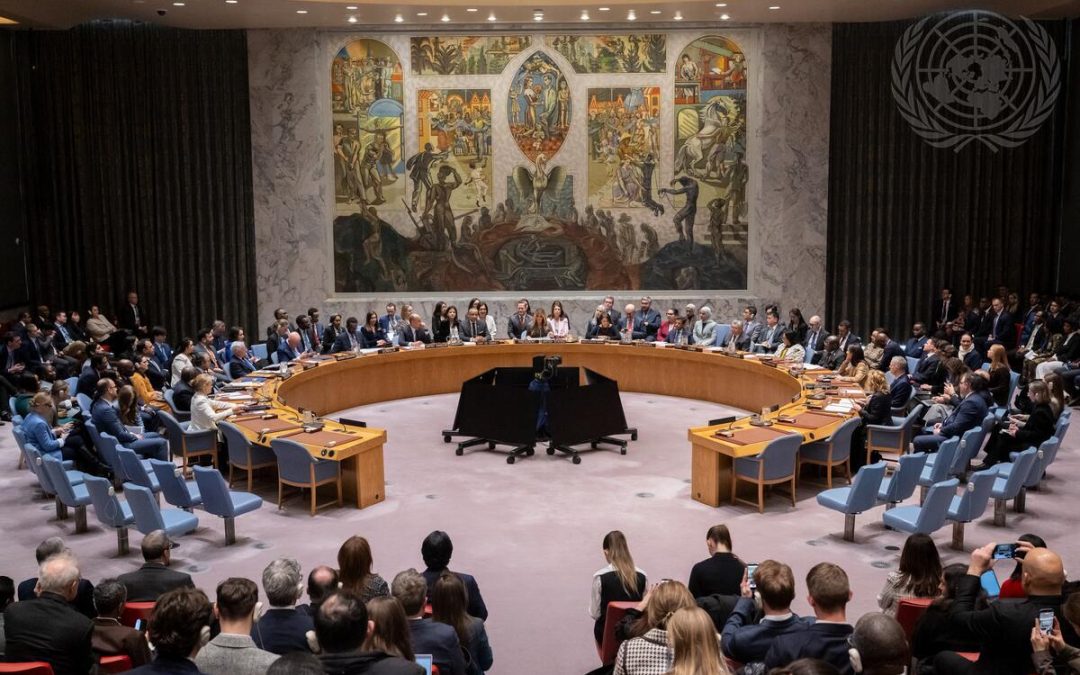
During the open debate of the Security Council held on Monday, March 2, 2026, on the theme “Children, Technology and Education in Times of Conflict,” the Permanent Representative of the Democratic Republic of the Congo to the United Nations, Ambassador Zénon Mukongo Ngay, delivered the statement of the Democratic Republic of the Congo. In it, the DRC reaffirmed the urgent need to protect children affected by conflict, ensure the continuity of their education, and promote the safe and inclusive use of technology, while calling for increased mobilization by the international community.
Below is the full text of the statement.
—————————————————————————————————–
Madam President,
At the outset, I would like to congratulate the United States of America on assuming the presidency of the Council for the month of March 2026 and to thank it for convening this meeting devoted to an issue whose importance is decisive and critical, both for my country and for many regions of the world affected by war and armed conflict.
In this regard, the Democratic Republic of the Congo welcomes initiatives aimed at strengthening international mobilization in support of the well-being and future of children in the digital age and reaffirms its commitment to any multilateral dynamic that helps protect children and guarantee their fundamental right to education. My country therefore wishes to pay special tribute to you, Most Distinguished First Lady of the United States of America, for your commitment to safeguarding the integrity and dignity of children around the world. We also thank Ms. Rosemary DiCarlo, United Nations Under-Secretary-General, for her briefing.
Madam President,
Ensuring effective access to education and digital technologies for children in conflict situations is, for the Democratic Republic of the Congo, an essential reality. For more than three decades, our country has experienced recurring cycles of violence and armed conflict, particularly in its eastern part. For thirty years, this situation has deprived millions of children of the enjoyment of a fundamental right: access to safe, inclusive and quality education.
By way of example, in South Kivu Province alone, where since the beginning of 2025 the M23 movement and the Rwandan Defence Forces (RDF) have been operating with impunity, in violation of our national laws, the Charter of the United Nations, the elementary principles of international law and international humanitarian law, the impact of the conflict on education is alarming:
-
First, free education is being undermined, as the Rwandan troops and M23 rebels have decided to impose school fees in private and public schools in the territories under their control;
-
Second, statistics show that out of 8,419 schools, 1,768 schools — including 71 nursery schools, 1,022 primary schools and 675 secondary schools — are currently no longer operational. Among them, 167 schools serving 72,214 pupils, including 36,068 girls, are, as we meet here today, occupied by armed groups.
Madam President,
As a general rule, the Democratic Republic of the Congo has made education a central pillar of its resilience and development policy.
With its essentially young human capital, education constitutes for my country not only a fundamental right, but also a major pillar of its stability. The policy of free education decreed by the President of the Republic, His Excellency Félix-Antoine Tshisekedi Tshilombo, since his accession to the highest office in 2019, reflects this vision of improving access to education and new technologies.
To this policy must be added the adoption, in 2025, of the Education and Training Strategy in Emergency Situations 2025–2029, aimed at building a resilient, inclusive and protective education system capable of ensuring continuity of learning before, during and after crises.
This aforementioned strategy is accompanied by the firm commitment of the Democratic Republic of the Congo to reduce the digital divide, which particularly affects areas impacted by conflict.
Madam President,
The use of digital technology is now an essential means of mitigating the effects of conflict on education. Digital platforms, mobile tools and distance-learning solutions can maintain an educational link for internally displaced children, those living in isolated areas, or in displacement camps.
Likewise, advances in artificial intelligence can help support teachers, adapt educational content and provide psychosocial assistance to children affected by trauma.
Madam President,
The Democratic Republic of the Congo is convinced that respect for and protection of human rights, particularly children’s rights, as well as international humanitarian law, must remain at the heart of all the strategies we may implement in order to ensure peace and security in the world. To that end, we must work collectively so that these dimensions, too often diluted in the approach to, analysis of, and assessment of conflicts, are given greater consideration.
This is why the Democratic Republic of the Congo calls for:
-
stronger international support for the development of digital infrastructure in fragile and post-conflict areas;
-
responsible partnerships with the private sector, based on transparency and accountability.
Madam President,
A land of major stakes, notably in view of its endowment with critical minerals essential to the global digital revolution, the Democratic Republic of the Congo believes that technology must never be a factor of exclusion for its children. On the contrary, it must become an instrument of resilience, recovery and equal opportunity.
In conclusion, the Democratic Republic of the Congo wishes to reaffirm its determination to work with all its partners, including the “Be Best” platform led by Distinguished First Lady Melania Trump, to protect its children, reform its education system, progressively integrate digital tools despite security challenges, and ensure that no child, even in a conflict situation, is discriminated against, but that each may continue to enjoy the right to education, development and the fulfillment of his or her legitimate dream of a better future in the digital age.
I thank you.