
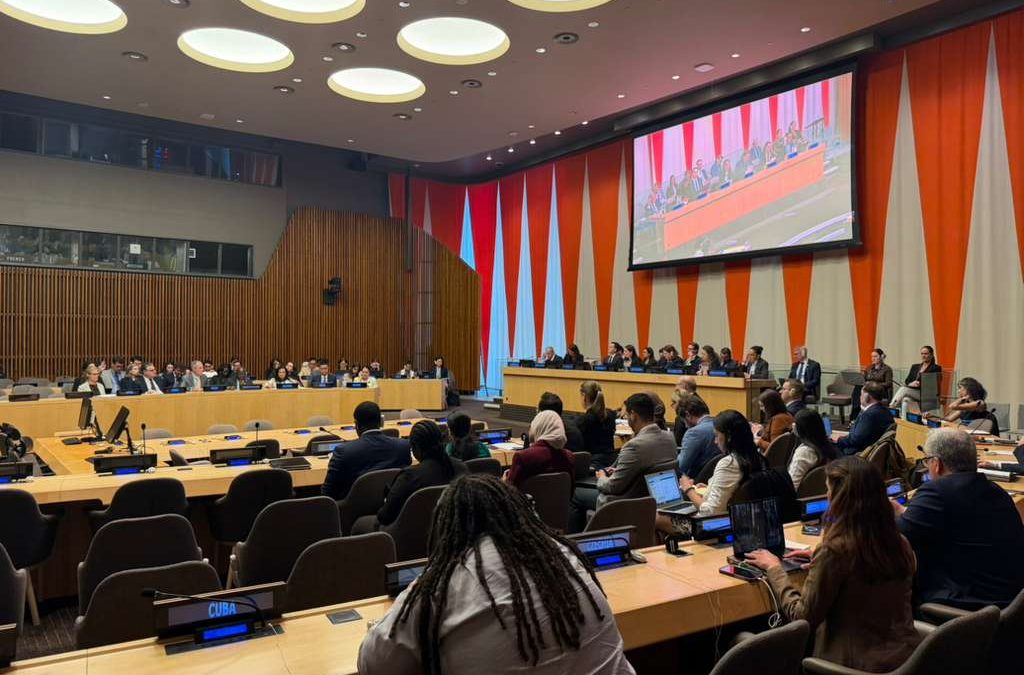
On the occasion of the Arria-formula meeting of the Security Council, held on 5 May 2026 in New York and devoted to the tenth anniversary of Resolution 2286 (2016), the Democratic Republic of the Congo reaffirmed its commitment to the protection of medical missions in armed conflict.
In its statement, the DRC condemned attacks, threats and obstructions targeting health facilities, medical and humanitarian personnel, patients and medical convoys. It recalled that such acts constitute serious violations of international humanitarian law and directly undermine the protection of civilian populations, regional stability and collective security.
The DRC also called on the Security Council to strengthen the operational implementation of Resolution 2286, particularly through improved prevention, rigorous documentation of violations, the use of accountability mechanisms, the integration of the protection of health care into the mandates of peace operations, and the fight against impunity.
For the Democratic Republic of the Congo, the protection of health care in times of conflict is not only a legal obligation, but also a moral, humanitarian and collective security imperative.
The full statement is published below.
—————————————————————————————————————————————
Madam President,
The Democratic Republic of the Congo thanks Denmark, New Zealand and Spain for organizing this meeting, which is taking place at a pivotal moment: ten years after the adoption of Resolution 2286 (2016), at a time when attacks against health care have reached an alarming level in many conflict theatres, particularly in the Middle East, the Sahel, the Great Lakes region, Ukraine, Myanmar, Sudan and Haiti, where health facilities, medical personnel and patients continue to be targeted or obstructed in the performance of their duties.
Madam President,
The Democratic Republic of the Congo, which has paid a heavy human and humanitarian toll over the past three decades, fully appreciates the significance of this resolution. Indeed, the adoption of Resolution 2286 marked a major turning point in the approach to armed conflicts, particularly by strengthening the principle of proportionality in times of conflict and reaffirming the absolute obligation to respect and protect the wounded, the sick, medical and humanitarian personnel, as well as health facilities. Yet, ten years after its adoption, it must be acknowledged that the commitments enshrined in this resolution continue to be widely ignored.
Taking advantage of this platform, the Democratic Republic of the Congo firmly condemns all attacks, threats and obstructions targeting medical and humanitarian personnel, whether committed by armed groups or occurring within broader security dynamics involving State or non-State actors. Such violations constitute not only a serious breach of international humanitarian law and medical neutrality, but also a direct threat to regional stability and the protection of civilian populations.
Madam President,
My delegation believes, first, that Resolution 2286 (2016) must be used beyond its normative scope, as an operational instrument for prevention, documentation and accountability. Second, we believe that the relevant mechanisms of the Security Council, including sanctions regimes, could usefully pay increased attention to the perpetrators, sponsors and supporters of attacks against health care, particularly when such attacks occur in hybrid or cross-border configurations.
In the specific case of my country, repeated attacks on its sovereignty and integrity, particularly in the East, are sufficient to highlight this reality. Successive reports of the United Nations Group of Experts on the Democratic Republic of the Congo have, in this regard, documented the persistence of attacks perpetrated against health facilities, medical convoys, patients, and humanitarian and medical personnel, in addition to obstructions to access to health care and the continuity of essential services. International medical organizations, including Médecins Sans Frontières, have repeatedly warned of the deterioration of the security environment in health facilities, displacement sites and conflict areas.
In Sudan, the gravity of the humanitarian situation, combined with the intensification of hostilities, including in areas affected by the activities of the Rapid Support Forces, sharply illustrates the vulnerability of medical infrastructure, health personnel and civilian populations. Available information indicates a significant number of incidents targeting health care, as well as serious obstructions to humanitarian access.
All of this reminds us of one clear reality: when health facilities cease to be protected spaces, when ambulances become targets and when humanitarian workers are prevented from carrying out their mission, the entire humanitarian architecture is shaken. In this regard, the protection of medical missions must once again become an operational, political and legal red line for the Security Council.
Madam President,
The threats facing medical care have become deeply diversified: direct attacks, administrative obstructions, the instrumentalization of health facilities, disinformation and the misuse of emerging technologies. In response to this evolution, the Democratic Republic of the Congo believes that the Security Council could usefully:
– Systematically integrate the protection of health care into the mandates of peace operations, with appropriate performance indicators and monitoring mechanisms;
– Strengthen early warning, particularly through more detailed reports by the Secretary-General;
– Consider the establishment of an inter-agency mechanism dedicated to the protection of medical missions, inspired by existing mechanisms for the protection of civilians; and finally,
– Promote renewed political commitments through appropriate instruments of the Council.
These orientations are in line with efforts undertaken at the national level, including the integration of the protection of health care into the operational directives of the Armed Forces of the Democratic Republic of the Congo, the development of mandatory training in international humanitarian law, the establishment of temporary humanitarian corridors, and the strengthening of cooperation with humanitarian partners and United Nations agencies.
Finally, the fight against impunity remains essential. Rigorous documentation of attacks, recourse to sanctions mechanisms and support for national jurisdictions are indispensable levers to prevent the recurrence of violations.
In conclusion, as we commemorate the tenth anniversary of the adoption of Resolution 2286, it remains imperative to transform commitments into concrete actions, fully adapted to realities on the ground and emerging risks. Indeed, the protection of health care is not only a legal obligation: it is a moral, humanitarian and collective security imperative.
Thank you.