
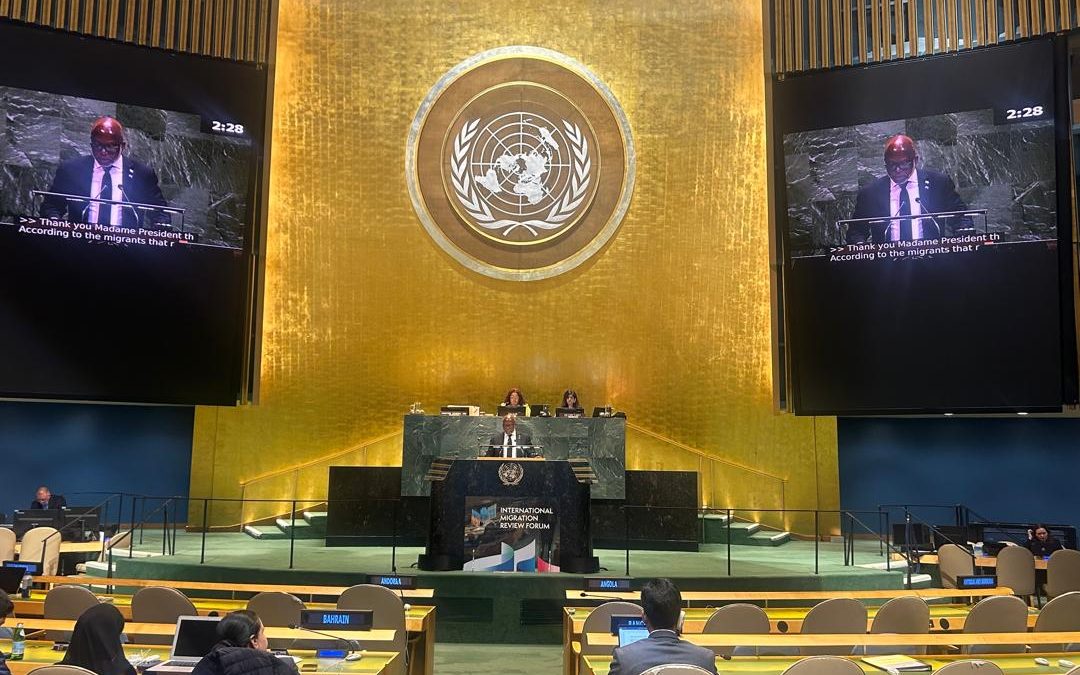
New York, 7 May 2026 — The Democratic Republic of the Congo took part, at United Nations Headquarters, in the general debate of the International Migration Review Forum, during which it reaffirmed its commitment to humane, integrated migration governance aligned with the objectives of the Global Compact for Safe, Orderly and Regular Migration.
The statement of the DRC was delivered by Mr. Jean-Claude Mbwankiem Niaroliem, Director and Head of the Department for Congolese Abroad at the Ministry of Foreign Affairs, International Cooperation, Francophonie and Congolese Diaspora.
Fully aligning itself with the statement of the African Group, the DRC supported the call for greater coherence between migration, climate and development policies. It recalled that African migration dynamics must be understood in all their complexity, taking into account internal mobility, cross-border movements, the protection of displaced persons, as well as the socio-economic realities specific to the continent.
In its statement, the DRC emphasized that migration is neither a new phenomenon nor an isolated challenge. It is linked to the history, culture, geography and social realities of the country and the region. As such, it must be addressed with dignity, humanity, responsibility and solidarity.
The DRC reaffirmed its commitment to the objectives of the Global Compact for Safe, Orderly and Regular Migration, as well as to relevant African frameworks, including the Migration Policy Framework for Africa and the Kampala Convention. It also welcomed the operationalization of the African Migration Observatory and supported the strengthening of national and regional systems for the collection and harmonization of migration data.
The Congolese statement placed particular emphasis on the protection of young people and African migrant workers, who are often exposed to criminal networks. It also stressed the need to strengthen public policies on migration management, particularly in the areas of integrated border management, migrant protection, the fight against trafficking in persons, and the prevention of transnational organized crime.
The DRC further presented several national advances, including the Government’s validation of a roadmap accompanied by an action plan for the Congolese diaspora, the improvement of protection and assistance for Congolese nationals abroad, the strengthening of consular support, and increased cooperation with multilateral technical partners such as the International Organization for Migration and the Office of the United Nations High Commissioner for Refugees.
Addressing climate impacts, the DRC underscored that climate-related displacement, whether internal or cross-border, requires coordinated responses, proactive adaptation and the strengthening of community resilience.
Finally, the DRC highlighted the strategic role of the diaspora and remittances in national development. It encouraged initiatives aimed at reducing transfer costs, promoting digital solutions, and strengthening innovative mechanisms for investment by the Congolese diaspora.
The Democratic Republic of the Congo concluded by calling for genuine commitment by the Forum to the implementation of the objectives of the Global Compact, supported by adequate financial and technical assistance to States.