
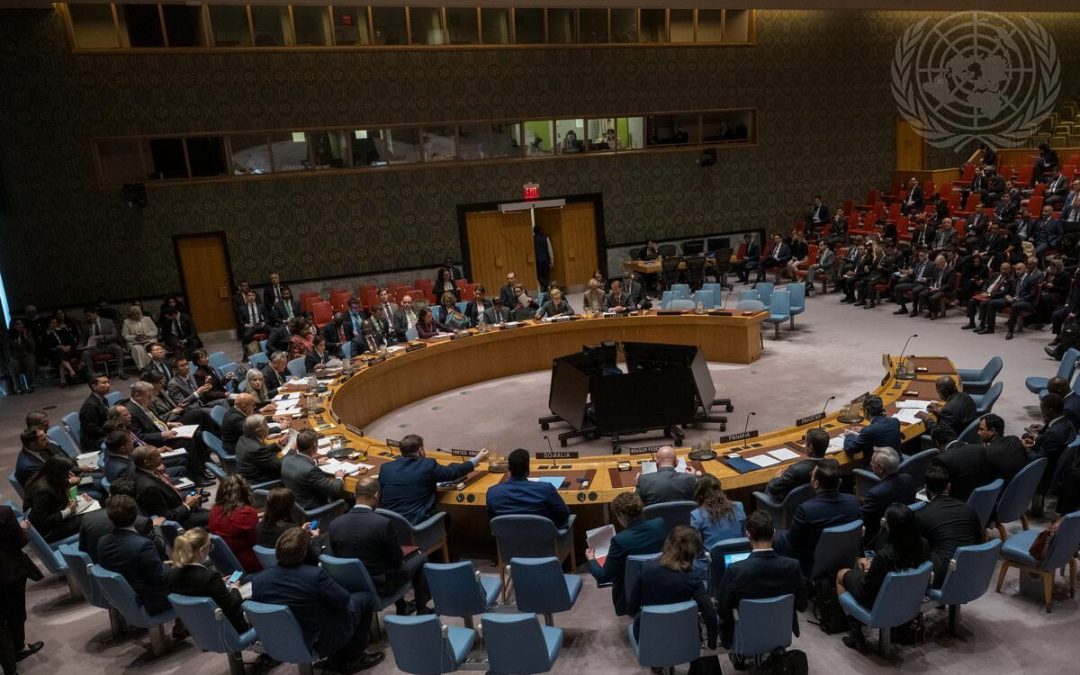
New York, 27 April 2026 — The Democratic Republic of the Congo reaffirmed, on Monday, 27 April 2026, before the United Nations Security Council, its commitment to strengthening maritime security and the protection of waterways, during the open debate on the maintenance of international peace and security under the theme: “The safety and protection of waterways in the maritime domain.”
The statement of the DRC was delivered by His Excellency Mr. Zénon Mukongo Ngay, Ambassador and Permanent Representative of the Democratic Republic of the Congo to the United Nations. The DRC commended the leadership of the Kingdom of Bahrain in guiding the work of the Council, as well as the briefings delivered by Mr. Arseno Dominguez, Secretary-General of the International Maritime Organization, and Mr. Nick Childs, Senior Fellow for Naval Forces and Maritime Security.
In its statement, the DRC recalled that seas and oceans constitute both a common heritage of humankind and an essential pillar of the global economy, as they ensure the smooth flow of international trade, support supply chains and sustainably connect nations. However, these strategic spaces are currently facing a convergence of threats that undermine freedom of navigation, weaken economies and disrupt commercial and energy flows.
The DRC drew the Council’s attention, in particular, to piracy, the illicit trafficking of migrants, transnational organized crime, as well as emerging threats targeting port infrastructure, navigation systems and vessels. These challenges, particularly visible in the Red Sea and the Gulf of Guinea, directly affect the security of coastal States, the lives of civilians and crew members, as well as the stability of supply chains.
For the Democratic Republic of the Congo, the response to these threats requires an integrated approach based on international and regional cooperation, prevention, innovation and strict respect for the rule of law. In this regard, the DRC underscored the importance of the United Nations Convention on the Law of the Sea, as well as the relevant instruments of the International Maritime Organization, which form the normative foundation for freedom of navigation, safety at sea and the peaceful settlement of disputes.
The DRC also recalled Africa’s efforts in maritime governance, including the adoption by the African Union of the African Charter on Maritime Security and Safety and Development in Africa, as well as the Yaoundé Code of Conduct, adopted in 2013 by twenty-five West and Central African States, including the Democratic Republic of the Congo, with a view to strengthening security in the Gulf of Guinea.
Addressing current tensions in the Middle East, the DRC highlighted the strategic importance of the Strait of Hormuz for global trade and the transport of essential goods and energy resources. It considered that the Security Council should remain fully seized of this situation and contribute, within the framework of its mandate, to preventing any deterioration likely to affect regional and international stability.
The DRC further called for the protection of civilians, crew members and maritime infrastructure, in strict compliance with international humanitarian law and the rules applicable to armed conflicts at sea. It encouraged ongoing mediation efforts, particularly those led by Pakistan, and called on all parties concerned to prioritize dialogue, restraint and de-escalation.
In conclusion, the Democratic Republic of the Congo proposed five key levers on which the Security Council could base its action: strengthening cooperation and coordination of international and regional efforts; integrating new emerging and technological threats; providing more substantial support to sustainable regional strategies; strengthening prevention and the resilience of coastal States; and promoting inclusive and preventive maritime governance grounded in respect for international law.