
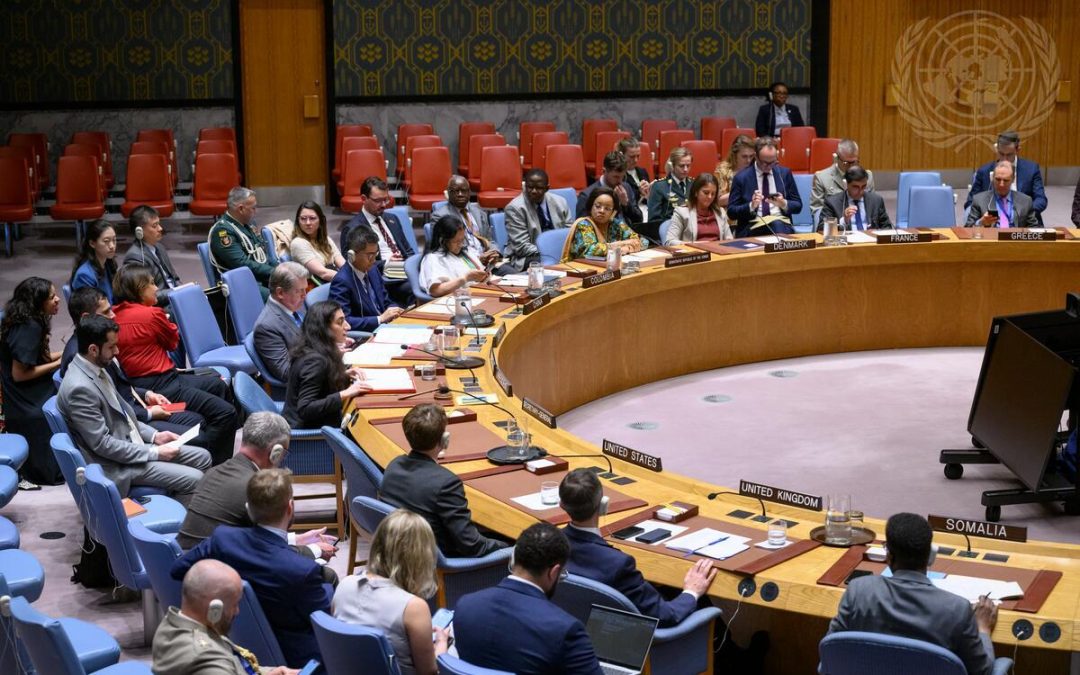
At the United Nations Security Council, the Democratic Republic of the Congo reaffirmed that peace operations can only deliver lasting results if they are anchored in a credible political process, respond to the expectations of populations, and adapt to evolving security environments. At the 10137th meeting devoted to United Nations peacekeeping operations, the DRC also highlighted challenges related to resources, mandate adaptation, and the need to strengthen partnerships, particularly with the African Union.
Please find below the full statement delivered by H.E. Ms. Jocelyne Kabengele Lukundula, Ambassador and Deputy Permanent Representative of the DRC to the United Nations.
Madam President,
I thank the Kingdom of Bahrain for convening this meeting. I also thank the Under-Secretary-General, Mr. Jean-Pierre Lacroix, Lieutenant General Humphrey Nyone, Force Commander of MINUSCA, and Major General Ganesh Kumar Shrestha, Force Commander of UNISFA, for their comprehensive briefings.
This session is taking place in a particular context, notably marked by liquidity constraints affecting the effective implementation of the mandates entrusted to United Nations peace operations.
The Democratic Republic of the Congo pays vibrant tribute to all peacekeepers, without distinction, for their constant commitment and the sacrifices made in often hostile environments, in the service of causes that transcend their national interests.
Madam President,
The reflection under way on the adaptation of peace operations, particularly within the framework of the Pact for the Future, responds to what has become an imperative requirement: aligning our tools with the profound transformation of security environments.
Peace operations remain essential instruments for the maintenance of international peace and security. However, their effectiveness rests on a delicate balance: they cannot substitute for politics, but must help create the conditions for it. Their success remains inseparable from the existence of credible political processes, the consent of host States, and predictable, adequate and sustainable resources.
In contexts marked by the fragmentation of armed actors, porous borders and the growing interconnection of national and regional dynamics, the issue is no longer merely the presence of missions, but their real capacity to adapt, to project their action and to produce tangible effects on the ground.
Madam President,
My delegation wishes to make three observations:
First, with regard to MINUSCA, the Democratic Republic of the Congo commends the efforts deployed by the Mission, particularly its support for securing the elections of 28 December 2025 and the preparations for those of 26 April 2026.
During the 2025–2026 period, the military component of MINUSCA undertook a notable adaptation of its posture through the decentralization of its elements toward the hinterland. This repositioning, combined with strengthened cooperation with the Central African Armed Forces, illustrates a determination to establish a more operational footing closer to local realities, which is essential in the fight against armed groups. The same applies to the support provided to the DDR process, which enabled the disarmament of more than 1,100 ex-combatants between July and December 2025.
However, these advances should not obscure the persistent structural challenges, including the fragility of the political framework and the spillover effects of regional crises on the country’s stability.
Second, with regard to the Joint Border Verification and Monitoring Mechanism, my delegation notes with concern the difficulties encountered in the implementation of UNISFA’s mandate, in a context marked by the deterioration of the political situation and the absence of sustained dialogue between Sudan and South Sudan on the status of Abyei.
The withdrawal from the sites of the Joint Verification and Monitoring Mechanism raises serious questions as to the Mission’s ability to continue performing its essential functions of monitoring, early warning and confidence-building.
Third, Madam President, the ongoing reflection on the future of peace operations reflects a major doctrinal evolution.
The gradual shift from multidimensional missions to lighter, more agile and modular configurations responds to an operational necessity. However, this transition cannot be purely technical: it calls for strategic clarification regarding the objectives pursued and the conditions for the success of these new models.
The increased integration of technological tools, the search for greater mobility, as well as the consideration of emerging threats such as disinformation or cyber risks, constitute relevant developments.
For example, in the DRC, MONUSCO is already making use of technology for surveillance and stabilization. It notably uses drones equipped with infrared cameras to monitor armed groups.
But beyond these adjustments, the primacy of politics must remain the structuring principle. Peace operations can only be conceived as temporary instruments serving negotiated political solutions. From this perspective, strengthening partnerships with regional organizations, in particular the African Union, appears essential.
Madam President,
For my delegation, experience from African theatres shows that the relevance of peace operations is not measured solely by their capacity to deploy, but by their ability to be part of a credible political dynamic, to respond to the expectations of populations and to adapt to constantly changing environments. It is on that condition that they will continue to constitute a central pillar of our collective peace and security architecture.
I thank you.