
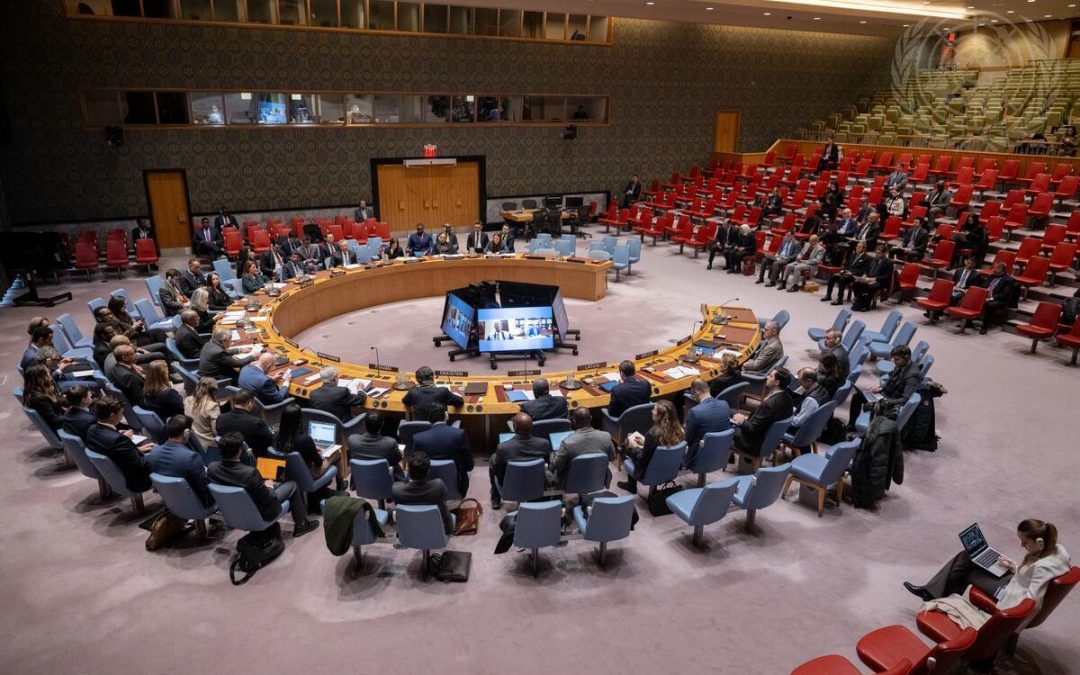
Monday, January 26, 2026, Security Council, 10096th meeting – Statement by the Democratic Republic of the Congo on the promotion and strengthening of the rule of law in the context of activities for the maintenance of international peace and security, delivered by the Deputy Permanent Representative of the Democratic Republic of the Congo, Ambassador Jocelyne Kabengele Lukundula.
———————————————————————————————-
Mr. President,
The Democratic Republic of the Congo congratulates the Federal Republic of Somalia on its presidency of the Security Council and thanks it for organizing this open debate. It also welcomes the presence of the Secretary-General of the United Nations, H.E. António Guterres; the Chairperson of the African Union Commission, H.E. Mahmoud Ali Yusuf; as well as the founding President of the African Institute of International Law, Judge Abdulqawi Yusuf.
This debate is being held at a pivotal moment, as we celebrate the eightieth anniversary of the Charter of the United Nations. As a country affected by armed conflicts, the Democratic Republic of the Congo remains deeply committed to the promotion of international peace and security based on respect for the international rule of law.
Mr. President,
Eighty years after the adoption of the Charter, the Security Council is called upon to undertake a clear-eyed reflection on the progress achieved, but also on the persistent challenges relating to respect for the rule of law among nations. The gradual erosion of this normative foundation weakens multilateralism and fuels a crisis of confidence in international institutions.
The international rule of law is the cornerstone of the multilateral system. It is based on respect for the Charter of the United Nations, the good-faith observance of international obligations, and the strengthening of the Organization’s three pillars: international peace and security, human rights, and development.
Mr. President,
The principles enshrined in the Charter, in particular respect for sovereignty, territorial integrity, and the prohibition of the use of force, continue to be severely tested in several regions of the world. These recurrent violations undermine the credibility of the international legal order and weaken trust among States.
In this regard, the persistent security situation in the eastern Democratic Republic of the Congo illustrates the challenges facing the multilateral system when the fundamental principles of the Charter are not fully respected. Despite my country’s engagement in regional mechanisms for the peaceful settlement of disputes, under the aegis of the African Union and in accordance with Chapter VIII of the Charter, results on the ground remain below expectations.
This reality recalls the importance of the effective implementation of Security Council decisions, particularly those calling for strict respect for territorial integrity and the cessation of any non-consensual foreign military presence.
Mr. President,
Multilateralism is currently going through a period of fragility marked by the resurgence of armed conflicts, the rise of unilateralism, and the effects of global crises. In this context, it is imperative to reaffirm that the international rule of law remains the preferred path for preventing conflicts, promoting justice, and ensuring lasting peace.
Chapter VI of the Charter of the United Nations, relating to the peaceful settlement of disputes, remains an essential and at times underused tool. Its more systematic activation, combined with greater recourse to mediation, preventive diplomacy, and international judicial mechanisms, would help replace force with law in the conduct of international relations.
Mr. President,
The consolidation of the international rule of law also requires better coordination among the various organs of the United Nations, in accordance with their respective mandates. Coherent action by the Security Council, the General Assembly, the International Court of Justice, and regional organizations would strengthen the legitimacy and impact of collective efforts in support of peace. In this dynamic, regional organizations, particularly African ones, are playing an increasingly important role in the peaceful settlement of disputes and in strengthening the legal and institutional capacities of States.
Mr. President,
The Democratic Republic of the Congo calls on the Security Council to fully assume the responsibility conferred upon it by Article 24 of the Charter by placing the promotion and strengthening of the rule of law at the heart of all United Nations actions. This implies, in particular, the rigorous implementation of adopted resolutions, increased support for fragile States, and the coherent use of the instruments at the Council’s disposal. Likewise, in conflict situations, it remains crucial for the Council to work to ensure that humanitarian actors are guaranteed unhindered access in order to assist civilian populations lacking support.
In conclusion, the Democratic Republic of the Congo reaffirms its unwavering attachment to the ideals and principles of the Charter of the United Nations. It remains committed to collective action aimed at building an international order based on law, justice, and multilateralism, as guarantees of lasting and inclusive peace.
I thank you.