
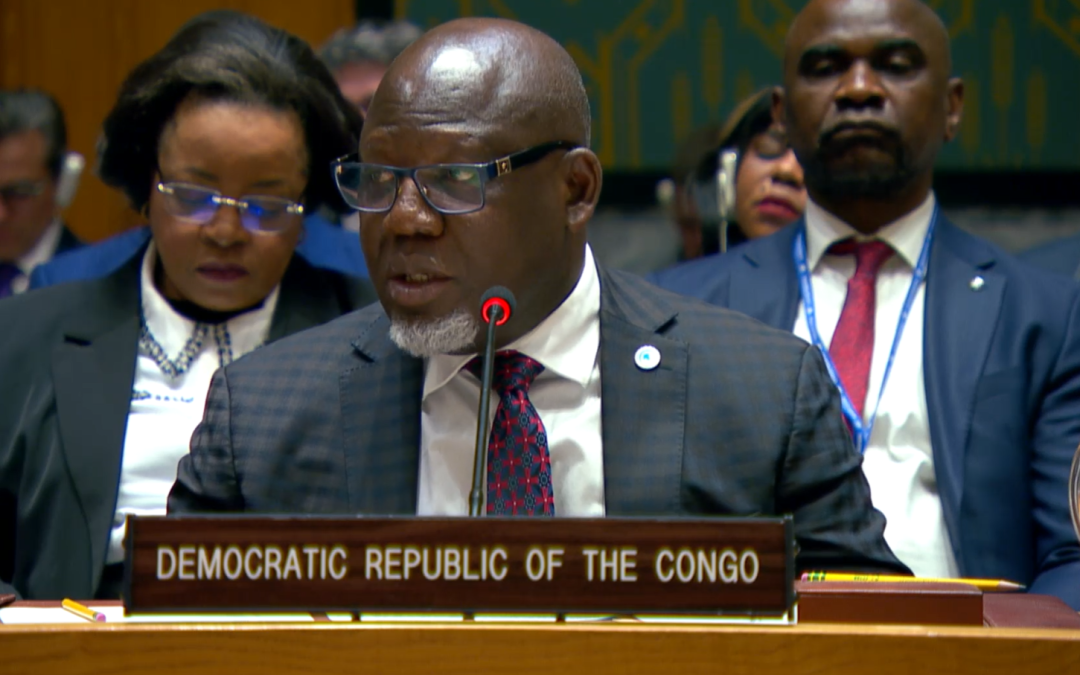
New York, 5 March 2026 — The Permanent Representative of the Democratic Republic of the Congo to the United Nations, Ambassador Zénon Mukongo Ngay, delivered the DRC’s statement during the 10114th meeting of the United Nations Security Council, held under the theme “Energy, Critical Minerals and Security.”
In his remarks, the DRC noted that the global energy and digital transition, while accelerating worldwide demand for strategic minerals — including cobalt, coltan, lithium, gold and rare earth elements — may also increase risks to international peace and security, particularly in fragile contexts. The Permanent Representative recalled that despite the country’s immense reserves, these resources have often fuelled competition and cycles of violence rather than supporting development.
Referring to the national context, the DRC emphasized that for nearly three decades, the eastern part of the country has been affected by persistent violence largely linked to the illegal exploitation and trade of natural resources, with major humanitarian consequences, including mass displacement and the long-term weakening of economic and social structures. In this regard, the statement referred to targeted sanctions imposed by the United States against actors considered to be destabilizing forces in the Great Lakes region.
“This is an appropriate moment to thank the United States for having taken the step of imposing targeted sanctions against the troublemakers in the Great Lakes region, namely the Rwandan Defence Forces and their M23 auxiliaries,” emphasized the Permanent Representative of the DRC to the United Nations.
Beyond the Congolese case, the DRC noted that the link between natural resources and conflict can be observed in several regions of the world, where competition for control over strategic resources fuels war economies, organized crime and human rights violations, with cross-border consequences.
In response to these challenges, the DRC called for the promotion of responsible, transparent and inclusive governance of mineral resources, focusing on:
-
Strengthening traceability and transparency in critical mineral supply chains;
-
Combating fraud, smuggling and illegal exploitation;
-
Creating local added value, notably through the processing of minerals in producing countries;
-
Ensuring that the private sector complies with national legislation and principles of social and environmental responsibility, in order to prevent any direct or indirect financing of armed groups.
The DRC also highlighted its commitment to concrete initiatives, including the Kimberley Process for diamond traceability, as well as the ICGLR Regional Certification Mechanism, which is based on the OECD due diligence principles for responsible mineral supply chains.
In conclusion, the DRC stressed that the global energy transition must not reproduce the injustices of the past and reaffirmed its willingness to work with all partners to promote fair, transparent and responsible governance of natural resources, in the service of peace, security and sustainable development.