
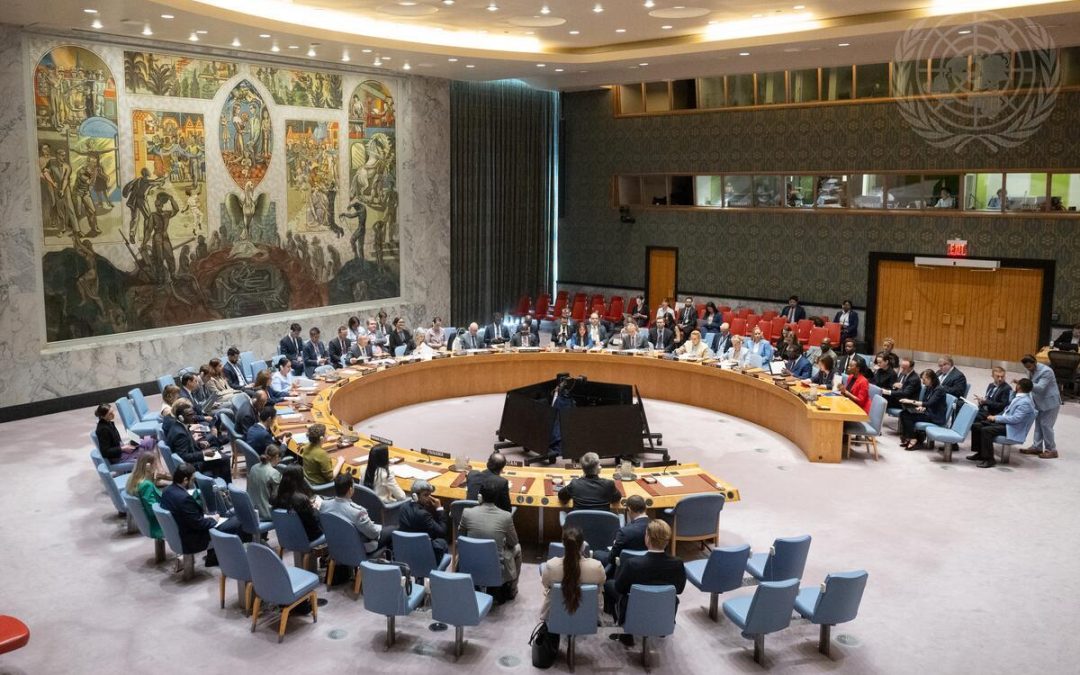
During the Security Council’s open briefing on the security and humanitarian situation in Ukraine, the Democratic Republic of the Congo reaffirmed its commitment to the purposes and principles of the United Nations Charter, international law, and international humanitarian law.
In its statement, the DRC expressed grave concern over the ongoing hostilities and their devastating impact on civilian populations. It called on the parties to strictly protect civilians and critical infrastructure, to ensure rapid, safe, sustainable, and unimpeded humanitarian access, and to prioritize the path of diplomacy, dialogue, and mediation.
The Democratic Republic of the Congo emphasized that there can be no military solution to this conflict and encouraged all efforts likely to bridge differences, restore trust, and pave the way for a just, sustainable, and credible peace.
The statement by the Democratic Republic of the Congo is published in full below.
—————————————————————————-
Mr. President,
The continuing deterioration of the security and humanitarian situation in Ukraine warrants sustained attention from the international community in general and from this Council in particular. Worse still, this war is becoming more sophisticated, more widespread, and more brutal with each passing day, exposing millions of civilians to unspeakable suffering.
In this regard, the Democratic Republic of the Congo would like to thank Ms. Kayoko GOTOH and Ms. Edem WOSORNU, respectively Director and Officer-in-Charge for Europe, Central Asia, and the Americas in the United Nations Department of Political and Peacebuilding Affairs, and Director of the Operations Division in the United Nations Office for the Coordination of Humanitarian Affairs, for their briefings on the security and humanitarian situation in Ukraine.
Mr. President,
As this meeting takes place at a time when our Organization is commemorating the protection of civilians in armed conflict, recent developments starkly remind us of how urgent it remains for this Council, as well as the entire international community, to redouble its efforts to bring a definitive end to this war that has gone on for far too long.
Indeed, the protection of civilians cannot remain a mere principle or slogan invoked in our debates. It must constitute a concrete, immediate, and non-negotiable obligation. It is worth recalling in this regard that every additional attack on populated areas, every retaliation, every escalation of hostilities further distances the prospects for a peaceful and lasting settlement.
Mr. President,
The Democratic Republic of the Congo reiterates its conviction that there can be no military solution to this conflict. The events of the weekend demonstrate this amply. Indeed, the dangerous escalation observed in recent hours cannot contribute to creating a positive dynamic toward the establishment of a credible and lasting ceasefire between the parties.
Moreover, my delegation expresses its deep concern regarding the new threshold crossed in this war, where we are helplessly witnessing both an escalation by the parties and a disturbing transformation of this conflict that portends only one outcome: horror and despair for entire generations of adults, young people, and children held hostage by a logic of confrontation with dramatic humanitarian consequences that pushes any prospect of a political settlement further out of reach.
Each day, the risk of collateral damage to civilian populations increases exponentially. Yet there is no need to reiterate the sacrosanct principles of international law and the United Nations Charter that guide our collective action; these principles establish, in particular, that civilian populations must never be targeted, nor must civilian infrastructure—including energy networks, health facilities, schools, homes, and facilities necessary for the provision of essential services—which must be protected under all circumstances.
Mr. President,
The briefings presented to us are unequivocal. The humanitarian situation in Ukraine demands our utmost attention. In this regard, my delegation reiterates the need for all parties to the conflict to ensure rapid, safe, sustainable, and unimpeded access to all persons in need, in accordance with the relevant provisions of international law and international humanitarian law.
We also reiterate the need to protect humanitarian personnel, medical workers, and relief infrastructure. Particular attention must be paid to displaced populations, women, children, the elderly, and persons with disabilities.
Mr. President,
The war in Ukraine serves as a profound lesson. It demonstrates that when a conflict drags on to the point of blurring the lines between the battlefield and civilian areas, it ultimately undermines not only the security of populations but also the very foundations of international stability.
Indeed, as we mentioned earlier, this conflict, even beyond the immediate operational theater, continues to produce troubling transnational effects, notably the recruitment of foreign nationals—including those from the African continent—sometimes under questionable conditions. These are sufficient indicators that should convince us of the urgent need to put a definitive end to the logic of endless stalemate that today seems to have taken precedence over all reason and responsibility.
Mr. President,
Recent developments show with alarming clarity that the longer this war drags on, the more profound and widespread its human, humanitarian, and security consequences become.
In conclusion, the Democratic Republic of the Congo urges the parties to break with the logic of confrontation and to give peace a real chance by resolutely prioritizing the path of diplomacy.
Faced with this reality, our collective responsibility cannot be one of resignation. It must be one of diplomatic action and the strict protection of civilian populations. In this regard, the Democratic Republic of the Congo encourages all diplomatic and mediation efforts likely to bring positions closer together and restore trust between the parties, as illustrated by the recent prisoner-of-war exchanges, which demonstrate that channels for dialogue remain possible and must be preserved.
Thank you.