
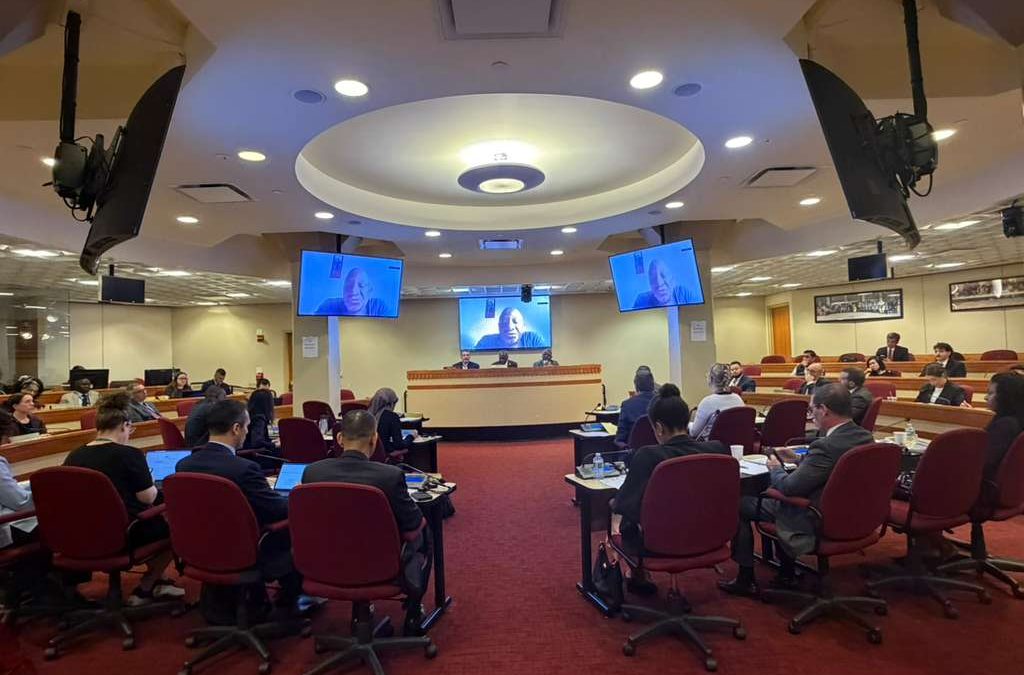
New York, May 18, 2026 — The Democratic Republic of the Congo, in its capacity as Coordinator of the A3 group at the United Nations Security Council, participated in a roundtable discussion on the protection of civilians in contexts of high-intensity conflict and peace enforcement.
In his opening remarks, H.E. Zénon Mukongo Ngay, Ambassador and Permanent Representative of the DRC to the United Nations, emphasized the need to strengthen operational capacities, cooperation between the African Union and the United Nations, and sustainable support mechanisms for the protection of civilian populations affected by armed conflict.
The DRC also highlighted the importance of the African Union Policy on the Protection of Civilians adopted in 2023, as well as the opportunities offered by the implementation of Security Council Resolution 2719 to strengthen African peace operations.
The statement by the Democratic Republic of the Congo is published below in its entirety.
Excellencies,
Distinguished Colleagues,
Ladies and Gentlemen,
It is an honour for the Democratic Republic of the Congo, in its capacity as Coordinator of the A3, to be part of convening this important roundtable on “Protecting Civilians in Peace Enforcement Settings: The AU PoC Policy and the realities of high-intensity conflict.” I wish to commend the African Union Permanent Observer Mission, our fellow A3 members (Liberia and Somalia) as well as the UN Department of Peace Operations, CIVIC and Germany for your co-sponsorship, bringing this strategic discussion to the forefront of PoC Week 2026.
This conversation could not be more timely. Across our continent and beyond, the protection of civilians continues to stand as one of the clearest measures of the legitimacy, credibility, and effectiveness of contemporary peace operations. Yet, the reality confronting regional and international actors today is that the environments in which protection mandates must be implemented are becoming increasingly volatile, politically complex, and operationally constrained. Civilians continue to bear the heaviest burden of armed conflict, including through displacement, violations of human rights, conflict-related sexual violence, attacks against essential infrastructure, and the devastating consequences of terrorism and asymmetric warfare.
For the African continent, this is not an abstract policy debate. It is a lived and urgent reality. The persistence of instability in several regions of Africa continues to demonstrate that the effectiveness of peace operations cannot be divorced from their ability to respond credibly to the protection needs of civilian populations. At the same time, it also demonstrates that mandates alone are insufficient. Protection responsibilities must be matched with political unity, sustainable financing, required operational capabilities, strategic partnerships, and realistic expectations regarding the environments in which these missions operate.
It is precisely in recognition of these realities that the African Union adopted its Protection of Civilians Policy in Peace Support Operations in 2023. The Policy represents an important normative and operational milestone for the continent. It reflects the AU’s accumulated experience across diverse mission settings and establishes a multidimensional framework anchored on prevention, proactive protection, accountability, and coordination. Importantly, it also signals Africa’s determination to shape the global protection agenda not only as a theatre of operations, but as a strategic actor contributing ideas, doctrine, and lessons drawn from experience on the ground.
Excellencies,
As regional organisations increasingly assume responsibilities in high-intensity and enforcement-oriented settings, there is an urgent need for frank reflection on how protection mandates can realistically and effectively be implemented under severe political, logistical, and financial constraints. This requires moving beyond declaratory commitments towards a more strategic conversation about capabilities, mission design, civilian harm mitigation, intelligence and early warning capacities, host-state cooperation, and the importance of predictable and sustainable support frameworks.
In this regard, the implementation of Security Council resolution 2719 presents a significant opportunity to strengthen AU–UN cooperation in support of African-led peace operations. Such cooperation will enable shared strategic planning, coherent mandate implementation, robust accountability frameworks, and strengthened support for the protection of civilians in the most difficult operational theatres.
Today’s roundtable therefore offers an important platform not only to examine the operational realities of civilian protection in high-intensity environments, but also to advance a broader strategic discussion on the future of peace operations, regional ownership, and multilateral cooperation in maintaining international peace and security.
The Democratic Republic of the Congo and the A3 looks forward to engaging constructively in this important discussion and to working collectively towards practical and action-oriented outcomes that strengthen the protection of civilians across our continent.
I thank you.