
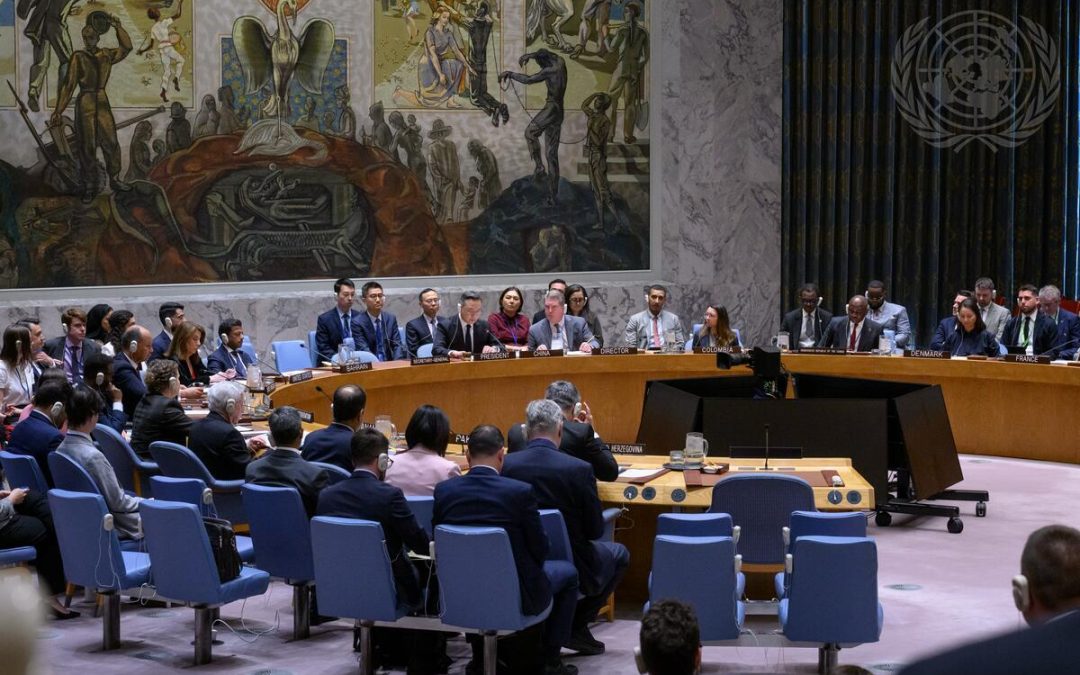
New York, 12 May 2026 — The Democratic Republic of the Congo took part, on Tuesday, 12 May 2026, in the 10150th meeting of the Security Council, devoted to the situation in Bosnia and Herzegovina. The statement of the DRC was delivered by Mr. Serge Banza Ngoy, Minister-Counsellor and Political Coordinator for Security Council-related matters at the Permanent Mission of the Democratic Republic of the Congo to the United Nations.
Before addressing the item on the agenda, the DRC congratulated the People’s Republic of China on assuming the presidency of the Security Council for the month of May, while reaffirming its commitment to working, alongside the other members of the Council, to promote international peace and security, in accordance with the purposes and principles of the Charter of the United Nations.
Speaking on the situation in Bosnia and Herzegovina, the Democratic Republic of the Congo expressed its concern over signs of fragility observed in the country, particularly persistent political tensions, divisive rhetoric, allegations of discrimination, as well as any action likely to call into question the established constitutional order.
The DRC recalled that the General Framework Agreement for Peace in Bosnia and Herzegovina, known as the Dayton Agreement, remains the foundation of peace, institutional stability and peaceful coexistence among the constituent peoples of that country. Thirty years after its conclusion, the Agreement remains an essential framework to be preserved and implemented in good faith.
The DRC also took note of concerns expressed regarding secessionist tendencies attributed to certain leaders of Republika Srpska, as well as the risks that such dynamics would pose to the constitutional order, sovereignty and territorial integrity of Bosnia and Herzegovina.
In this regard, the DRC called on all political leaders, at all levels, to exercise restraint and responsibility, and to refrain from any inflammatory rhetoric, hate speech, unilateral initiative or act that could weaken national cohesion and regional stability.
It encouraged all parties to prioritize inclusive dialogue, consensus-building and peaceful means, in accordance with the Dayton Agreement, the Constitution of Bosnia and Herzegovina, the decisions of the competent institutions and international law.
Emphasizing that lasting peace cannot be limited to the absence of armed conflict, the DRC stressed the importance of the rule of law, the regular functioning of institutions, the equal protection of all citizens, reconciliation and trust among communities.
The DRC further highlighted the importance of peaceful coexistence among the different communities of Bosnia and Herzegovina, considering that the country’s ethnic, cultural, linguistic and religious diversity must remain an asset protected by institutions, and not a factor of division.
It recalled that the duty of remembrance, justice and reconciliation are indispensable to the consolidation of peace, while warning against denialist rhetoric, the glorification of grave crimes established by competent jurisdictions, and the instrumentalization of identities.
The Democratic Republic of the Congo also took note of the role played by EUFOR Althea, authorized by the Security Council, in maintaining a safe and secure environment in Bosnia and Herzegovina, and encouraged the continuation of efforts in support of the stability of the country and the Western Balkans region.
In conclusion, the DRC reaffirmed its constant attachment to the purposes and principles of the Charter of the United Nations, in particular respect for the sovereignty, territorial integrity and political independence of States, as well as the peaceful settlement of disputes.
It reiterated its support for the sovereignty, unity, territorial integrity and political independence of Bosnia and Herzegovina, within its internationally recognized borders, and called on all parties to choose responsibility, dialogue, restraint and peaceful coexistence.